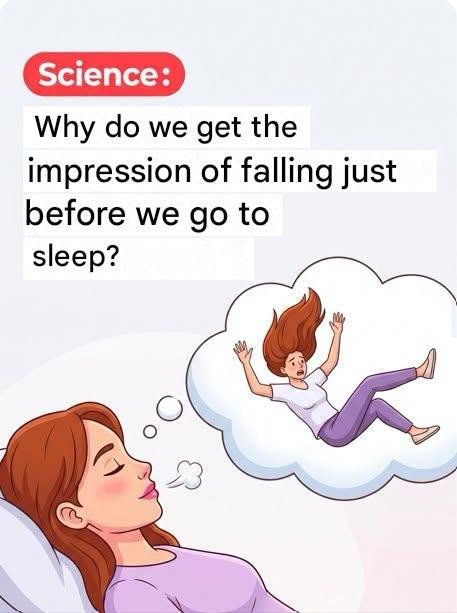
Here’s what’s happening in your brain and body in detail:
1. Your brain is transitioning between wakefulness and sleep
As you fall asleep, your brain shifts from beta waves (alert thinking) to alpha waves (relaxed wakefulness) and then to theta waves, which mark the beginning of light sleep (Stage N1).
During this transition:
- Your awareness of the outside world decreases.
- Your muscles begin to relax.
- Your heart rate slows.
- Your breathing becomes more regular.
This transition isn’t always perfectly smooth.
2. The motor system briefly misfires
Your brain contains networks that control movement, including areas such as the motor cortex, brainstem, and reticular activating system.
As these systems reduce muscle activity for sleep:
- Some motor neurons fire unexpectedly.
- A sudden burst of electrical activity travels to your muscles.
- One or several muscles contract all at once.
You experience this as a powerful jerk of your legs, arms, or entire body.
3. Your brain creates the “falling” sensation
Interestingly, the movement and the feeling of falling influence each other.
Your brain constantly combines information from:
- Your inner ear (balance)
- Your muscles and joints
- Your eyes
- Internal body signals
As muscle tone suddenly changes, your brain may briefly interpret the unusual sensory input as if you’re losing balance or falling.
Instead of accurately recognizing, “I’m entering sleep,” the brain can momentarily generate the perception:
“I’m falling.”
This is why many people dream of:
- Tripping
- Falling off a cliff
- Missing a step
- Slipping
4. The brain immediately triggers an emergency response
The perceived fall activates circuits involved in detecting threats.
Your brain rapidly:
- Increases alertness.
- Activates the sympathetic nervous system.
- Releases stress hormones such as adrenaline.
- Raises heart rate.
- Increases muscle tension.
Within a fraction of a second, you’re fully awake.
5. Why does it happen more when you’re stressed?
Hypnic jerks become more frequent when your nervous system is more easily activated.
Common triggers include:
- Stress
- Anxiety
- Sleep deprivation
- Excess caffeine
- Vigorous exercise close to bedtime
- Irregular sleep schedules
These factors make the transition into sleep less stable.
What scientists think is happening
There isn’t one universally accepted explanation, but several leading theories exist:
- Transition instability: The brain’s shift from wakefulness to sleep isn’t perfectly synchronized, leading to occasional bursts of motor activity.
- Evolutionary theory: As muscles relax, the brain may briefly misinterpret the sensation as falling from a tree, triggering a reflexive muscle contraction. This idea is interesting but remains speculative.
- Motor inhibition timing: Brain regions that suppress movement during sleep may not activate uniformly, allowing a brief burst of muscle activity before full inhibition takes hold.
Is it dangerous?
For most people, no.
Hypnic jerks are considered a normal part of falling asleep and don’t indicate brain damage or a neurological disease.
However, if the movements:
- occur repeatedly throughout the night,
- involve violent or prolonged shaking,
- happen during full wakefulness,
- or are associated with loss of consciousness,
it’s worth discussing them with a healthcare professional, as other sleep or neurological conditions may need to be ruled out.
A simple analogy
Think of your brain like an airplane switching from manual control (being awake) to autopilot (sleep). During the handoff, most of the time everything is smooth. Occasionally, there’s a brief communication glitch: one system mistakenly thinks you’re falling, sends an emergency correction to your muscles, and the “jolt” wakes you up before the transition completes.