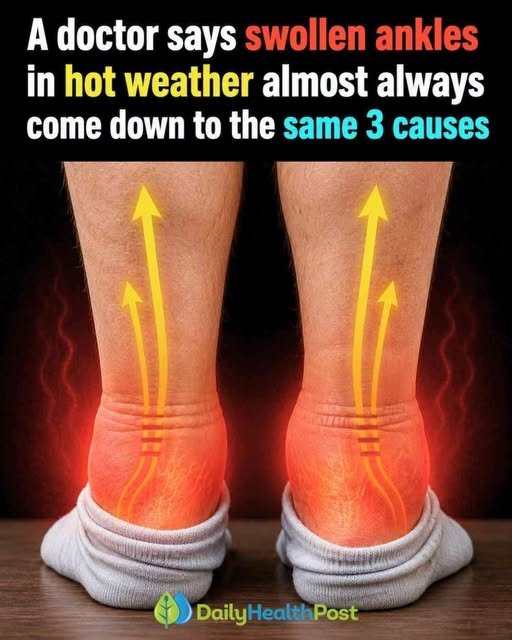
Here is a detailed explanation:
Why ankles swell more in summer
Your legs have to move blood upward against gravity from your feet back to your heart. The body relies heavily on the calf muscle pump to do this.
1. The calf muscle pump: your “second heart” for the legs
Inside your leg veins are tiny one-way valves that prevent blood from flowing backward.
When you walk or move:
- Your calf muscles contract.
- They squeeze the deep veins in your legs.
- This pushes blood upward toward your heart.
- The valves close behind the blood so it does not fall back down.
This action is called the calf muscle pump.
When you spend many hours:
- sitting at a desk,
- traveling,
- standing still,
- walking very little,
the calf muscles do not contract enough. Blood can pool in the lower legs, increasing pressure inside the veins.
That pressure pushes fluid out of the blood vessels and into surrounding tissues, causing:
- swollen ankles,
- puffy feet,
- tight shoes,
- sock marks around the ankles.
Why heat makes it worse
During hot weather, your body tries to cool itself by widening blood vessels near the skin. This process is called vasodilation.
When leg veins widen:
- they hold more blood,
- blood returns more slowly to the heart,
- pressure in the lower leg veins increases,
- more fluid can leak into tissues.
This is why many people notice:
- ankles swelling in the evening,
- shoes feeling tighter at night,
- swelling improving after sleeping.
Typical signs of harmless summer ankle swelling
Swelling is more likely to be simple heat-related fluid retention if:
- it affects both ankles,
- it appears after a long day,
- it improves overnight or after elevating your legs,
- there is no major pain,
- there is no breathing difficulty,
- the skin looks normal.
Things that make ankle swelling more likely
Long periods of sitting
Examples:
- office work,
- long car trips,
- flights.
The calf muscles stay inactive, reducing the pumping action.
Long periods of standing
Examples:
- shop workers,
- teachers,
- healthcare workers.
Gravity keeps blood pressure higher in the veins of the legs.
High salt intake
Salt causes the body to retain more water. More fluid in circulation can increase swelling.
Common high-salt foods:
- processed meats,
- packaged snacks,
- fast food,
- instant noodles,
- salty sauces.
Lack of movement
Weak or inactive calf muscles are less effective at pushing blood upward.
Age
As people get older:
- veins may become less elastic,
- valves may not work as efficiently,
- muscles may be less active.
Pregnancy
Hormonal changes and pressure from the growing uterus can slow blood return from the legs.
How to reduce summer ankle swelling
1. Walk regularly
Even short walks help activate the calf pump.
Try:
- walking 5–10 minutes every hour if sitting long periods,
- ankle circles,
- calf raises.
2. Elevate your legs
Lie down and raise your feet above the level of your heart for 15–30 minutes.
This helps gravity move fluid back into circulation.
3. Move your ankles while sitting
Simple exercises:
Ankle pumps
- Point toes forward.
- Pull toes toward your face.
- Repeat 20–30 times.
Calf squeezes
- Tighten calf muscles for a few seconds.
- Relax.
- Repeat.
4. Stay hydrated
It may seem counterintuitive, but dehydration can encourage the body to hold onto fluid.
5. Reduce excess salt
A moderate reduction in sodium can decrease water retention.
6. Consider compression socks
Compression stockings gently squeeze the legs, helping veins move blood upward.
They can be useful for:
- frequent travelers,
- people who stand all day,
- people with mild vein circulation problems.
When ankle swelling may need medical attention
Although summer swelling is often harmless, it is important to get medical advice if swelling is:
Sudden and only on one leg
Especially with:
- calf pain,
- warmth,
- redness,
- tenderness.
This can be a sign of a blood clot (deep vein thrombosis).
Associated with breathing problems
Seek urgent medical care if swelling occurs with:
- shortness of breath,
- chest pain,
- coughing,
- unusual fatigue.
Persistent or worsening
A doctor should evaluate swelling that:
- does not improve overnight,
- keeps increasing,
- is present every day,
- is accompanied by skin changes or ulcers.
Possible heart, kidney, or liver-related swelling
These conditions often have other symptoms, such as:
- swelling in multiple areas,
- breathlessness,
- changes in urination,
- unusual tiredness,
- abdominal swelling.
A simple way to think about it
Your legs are like a column of fluid that must be pushed uphill. In hot weather, the “pipes” (veins) relax and widen, and if the “pump” (calf muscles) is not working much, fluid can collect around the ankles.
For many healthy people, summer ankle swelling is a circulation and gravity issue, not a sign that the heart or kidneys are failing. However, the pattern of swelling and accompanying symptoms matter.