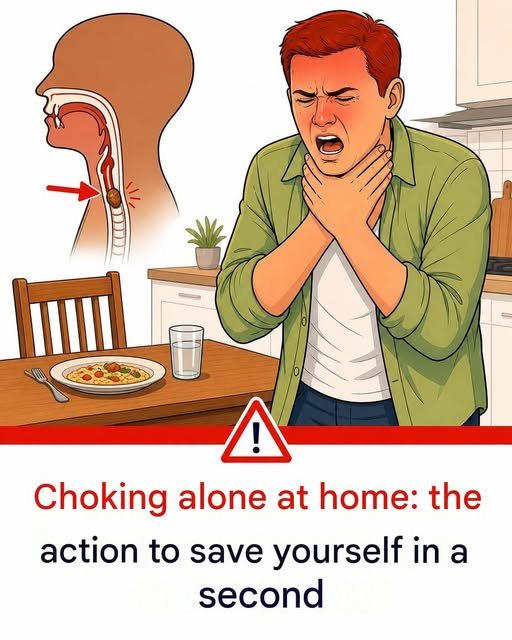
If this is happening right now and you cannot breathe, speak, or cough forcefully, treat it as a life-threatening choking emergency. Call 911 immediately—even if you think you may not be able to speak—and start the self-rescue maneuver below.
If you’re alone and choking: what to do
1. Recognize that this is severe choking.
A complete or severe airway blockage typically means you cannot speak, breathe normally, or produce a strong cough. You may instinctively grab your throat. This is different from mild choking, where you can still cough forcefully.
2. Call 911 first.
Use your phone’s emergency-call function. If you’re unable to talk, leave the line open if possible; the Red Cross says a 911 call from a GPS-enabled mobile phone can allow dispatchers to send help even if you cannot speak.
3. Perform abdominal thrusts on yourself.
- Make a fist with one hand.
- Put the fist slightly above your belly button—in the upper abdomen, below the breastbone.
- Grab your fist firmly with your other hand.
- Give yourself a hard, quick thrust inward and upward.
- Repeat forcefully until the food/object comes out or you can breathe again.
4. You can also use a firm, blunt surface.
If using your hands isn’t working, bend forward over a hard, stable surface such as the back of a sturdy chair or a countertop. Position the upper abdomen against the edge and drive your body inward and upward against it to create the abdominal thrust. The Red Cross specifically describes using a firm object such as a chair or railing as an alternative. Do not use a sharp corner or edge, and don’t use an unstable object that could cause you to fall.
5. Keep trying until the airway clears.
Once the object comes out, breathe slowly and assess yourself. If you remain injured, have persistent breathing problems, or feel that something is still stuck, obtain emergency medical evaluation.
What NOT to do
- Don’t stick your fingers blindly into your throat. You can push the food farther down. Only remove an object if you can actually see it.
- Don’t waste time drinking water when you have a blocked airway. A person with severe choking needs an airway-opening maneuver, not something to swallow.
- Don’t wait for it to resolve on its own if you cannot breathe or cough effectively.
- Don’t try to make yourself vomit.
If you can still cough forcefully
If you can breathe and cough forcefully, keep coughing. A strong cough may eject the obstruction. Don’t immediately perform abdominal thrusts while you’re producing an effective cough; monitor the situation closely and act if the cough becomes weak or you can no longer speak/breathe.
If you become unconscious
If you lose consciousness, you obviously cannot perform the self-rescue maneuver. If someone arrives, they should begin appropriate choking/CPR care. The Red Cross recommends CPR with chest compressions for an unresponsive choking person, looking in the mouth for the object between compression sets and removing it only if it is visible.
Important: The technique above is for an adult or older child who is conscious and choking on an object in the airway. Pregnancy and certain body sizes require chest thrusts rather than ordinary abdominal thrusts when rescuing another person.
For a visual, authoritative reference, the American Red Cross choking guide and Mayo Clinic’s choking first-aid guide provide demonstrations and detailed instructions.