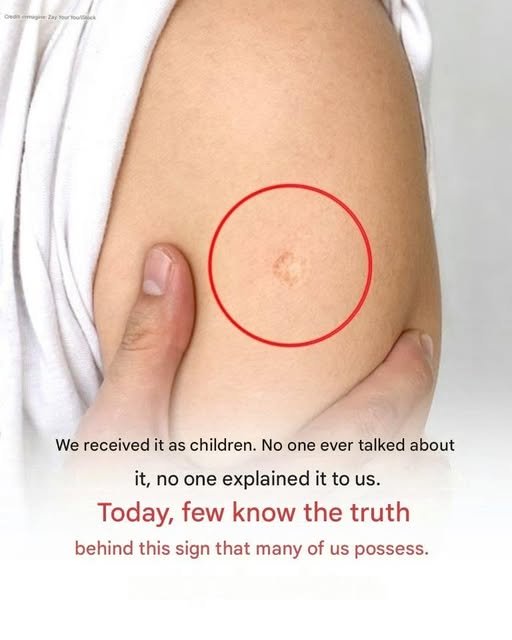
Yes. If you mean a small, round scar on the upper part of the left arm, especially one that you’ve had since childhood, the most likely explanation in many people is a BCG vaccination scar.
What does the scar mean?
BCG stands for Bacille Calmette-Guérin, a vaccine used primarily to protect against tuberculosis (TB), particularly severe forms of TB in children. It is routinely given in many countries outside the United States.
The scar occurs because BCG is given into the superficial layer of the skin (intradermally) rather than deep into the muscle. The normal immune reaction at the injection site can produce a small sore, which eventually heals and leaves a permanent scar.
Why is it often on the upper left arm?
The upper left arm has traditionally been used as a standardized location for BCG vaccination in many vaccination programs. This makes it easy for healthcare workers to recognize that someone may have received BCG. WHO documentation specifically describes BCG being given in the upper left arm.
What does a typical BCG scar look like?
A BCG scar is commonly:
- Small and round
- Around 4–7 mm across, although it can be larger
- Slightly depressed or raised
- Sometimes firm/hard to the touch
- Occasionally irregular around the edges
- Often becomes less noticeable as a person gets older
The vaccination itself can initially produce a small bump, followed by a local sore/ulcer. After healing, a small scar remains.
Does having the scar mean you have TB?
No. A BCG scar generally means that you previously received the BCG vaccine; it does not mean that you have tuberculosis.
Also, having a BCG scar does not guarantee a particular level of protection. WHO notes that scar formation is not itself a marker of how well the vaccine protected someone, and some vaccinated people never develop a visible scar.
Could it be something else?
Yes. A scar on the upper arm isn’t automatically a BCG scar. Depending on your age, country of birth, vaccination history, and the scar’s appearance, other possibilities include an old vaccination scar such as smallpox, or an ordinary injury, burn, insect bite, or other skin lesion. Smallpox vaccination scars tend to be larger and more deeply pitted than typical BCG scars.
If you tell me your age, the country where you were born/raised, approximately how big the scar is, and whether it is indented, raised, smooth, or pitted, I can explain in much more detail what it most likely is and why you have it.