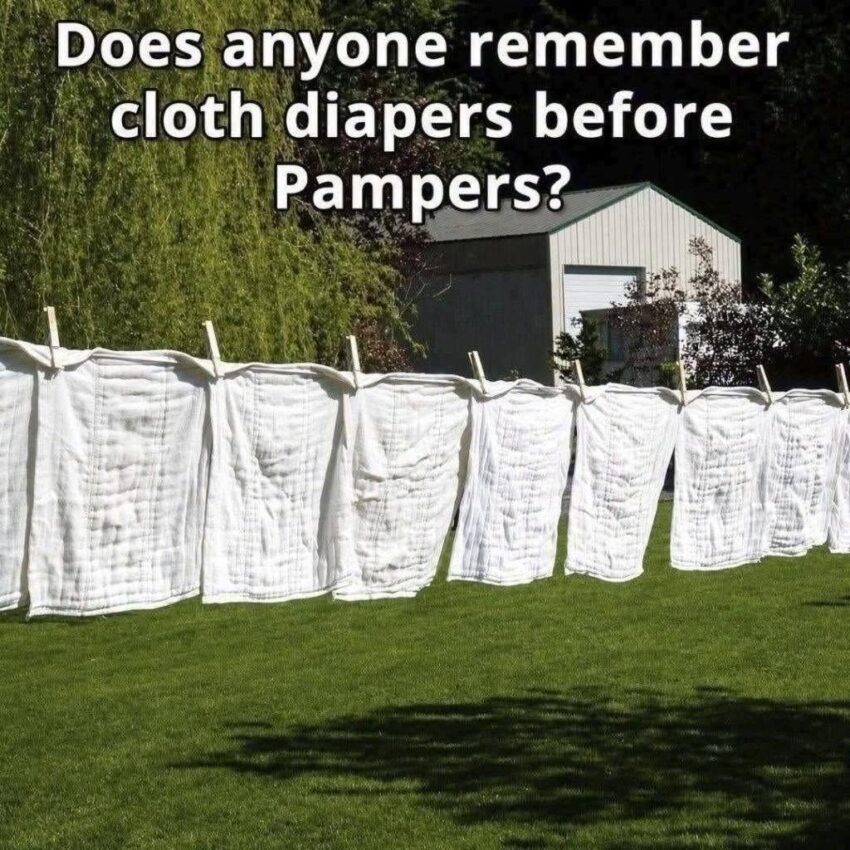
Yes. Cloth diapers existed for centuries before Pampers, and disposable diapers did not become widespread until the mid-20th century. Pampers was introduced in the United States in 1961, so anyone who remembers babies born before then may remember cloth diapers as the normal choice.
What diapers were like before Pampers
For much of history, there wasn’t one standardized “diaper” like the modern product. Families used whatever absorbent, washable material was available.
1. Ancient and early societies
Different cultures used materials such as:
- Animal skins and furs
- Moss
- Grasses and other plant fibers
- Cloth or linen
- Wool
- Leaves and other natural materials
In some societies, infants were also given considerable freedom to eliminate without a diaper, particularly when caregivers could observe the baby’s signals.
The exact practice varied enormously by region, climate, social class, and historical period.
2. Europe and North America
By the 18th and 19th centuries, cloth was increasingly common among families who could afford it.
A typical diaper might simply be a square or rectangle of linen, cotton, or other fabric, folded around the baby and secured with cloth ties or, later, safety pins.
There wasn’t necessarily a separate waterproof outer layer. As a result, urine could pass through the cloth onto clothing, bedding, or whatever surface the baby was lying on.
Parents dealt with this by:
- Changing the baby frequently
- Washing the cloth
- Hanging diapers outside to dry
- Using protective sheets or pads on beds
- Sometimes placing additional absorbent material inside the diaper
3. The famous “diaper pail”
By the late 19th and early 20th centuries, the routine familiar to older generations had become fairly recognizable.
A baby might have:
- A cloth diaper wrapped around the body.
- A rubber or rubberized cover over it to reduce leakage.
- A safety pin holding the diaper in place.
- Multiple changes throughout the day.
Used diapers were placed in a diaper pail until laundry day.
And yes—the smell could be formidable.
Families sometimes soaked dirty diapers in water or a cleaning solution before washing them. They then had to boil, scrub, rinse, wring, and dry them. Before modern washing machines and detergents, diaper laundry could be a substantial household chore.
What did “cloth diapers” actually look like?
They were much simpler than many modern cloth diapers.
A common style was essentially a large square of fabric:
        _________
       /         \
      /           \
     |   folded    |
     |    cloth    |
     |             |
      \           /
       \_________/
The caregiver folded the square into a suitable shape, positioned it between the baby’s legs, wrapped the sides around the body, and secured it.
Later, various specialized designs appeared, including prefold diapers, which had extra layers of absorbent fabric in the middle.
Safety pins
Safety pins became strongly associated with cloth diapering.
Parents had to be careful because an improperly positioned pin could injure the baby. Some families used special diaper pins with protective plastic or metal closures.
Modern parents sometimes imagine that people simply stabbed enormous safety pins through babies’ diapers. In reality, caregivers learned techniques for securing them safely, although accidents certainly could happen.
What about waterproof diapers?
This is an important part of the story.
Cloth itself isn’t waterproof.
Before disposable diapers, people developed various ways to deal with that problem. Rubber pants or waterproof diaper covers became increasingly common in the 19th and 20th centuries.
These could substantially reduce leakage, but they had drawbacks:
- They could trap heat and moisture.
- They could irritate the baby’s skin.
- They weren’t particularly breathable.
- They still needed cleaning or replacement.
Some older adults therefore remember babies wearing something like cloth + rubber pants.
What happened during the 20th century?
The biggest changes came from industrialization.
By the early 1900s, families could buy commercially manufactured diapers rather than making every diaper themselves. Cotton became increasingly important, and improvements in textile manufacturing made cloth diapers more practical.
Then came disposable diaper experiments.
Disposable diapers actually predate Pampers. Various forms of disposable infant undergarments and absorbent pads appeared during the early-to-mid 20th century.
But they weren’t initially cheap, convenient, or universally accepted.
Then came Pampers
In the 1950s, Procter & Gamble began developing a disposable diaper that could be manufactured on a large scale.
The person most associated with the development of Pampers was Victor Mills, a Procter & Gamble engineer who became involved in developing a better disposable diaper after being frustrated by the difficulty of diapering his grandchildren.
Pampers was introduced commercially in 1961.
The early Pampers were quite different from today’s diapers.
They generally had:
- An absorbent pad
- A waterproof outer layer
- Fasteners
- A relatively bulky design
And they were not immediately dominant.
Early disposable diapers were expensive compared with washing reusable cloth diapers. For many families, using disposables all the time simply wasn’t economically sensible.
Why did Pampers eventually win?
Several things changed simultaneously.
Washing machines
Automatic washing machines made laundry easier, but they didn’t eliminate the work of dealing with diapers.
A household still had to:
- Collect dirty diapers
- Wash them
- Rinse them
- Dry them
- Fold them
- Put them away
Disposable diapers eliminated almost all of that work.
Rising household incomes
As disposable income increased after World War II, some families became more willing to pay for convenience.
Better disposable technology
Disposable diapers gradually became:
- More absorbent
- Less bulky
- Better fitting
- Easier to fasten
- More reliable against leaks
More mothers entering the workforce
As women’s participation in paid employment increased, the time saved by disposable diapers became increasingly valuable.
So, did people “remember” life before Pampers?
Absolutely.
Someone born in, say, the 1930s, 1940s, or early 1950s could have very clear memories of cloth diapers.
A person born in the 1940s might remember a childhood in which:
“Babies wore cloth diapers, and Mom washed them.”
A baby born in the early 1960s might have been among the first generation to encounter Pampers, although cloth diapers remained extremely common.
In fact, Pampers did not suddenly replace cloth diapers in 1961. The transition took decades.
What laundry day could look like
This is probably the part that surprises people today.
Imagine a family with a newborn using cloth diapers exclusively.
The household might need dozens of diapers because a newborn can require many changes in a single day.
A typical cycle was:
Baby soils diaper → diaper goes into pail → diapers accumulate → soaking/rinsing → washing → possibly boiling or very hot washing → rinsing → hanging outdoors → drying → folding → storing → repeat.
And there was another issue:
You couldn’t just throw a diaper away.
Every diaper represented another piece of laundry.
This is why having enough diapers was important. A family could run into real trouble if the weather was bad, the laundry wasn’t done, or the baby was particularly messy.
What did babies wear at night?
Nighttime was particularly challenging.
A cloth diaper could become saturated during a long sleep. Families sometimes used:
- Multiple layers of cloth
- Larger nighttime diapers
- Extra absorbent material
- Waterproof covers
- Protective sheets on the mattress
Bed protection was important because a leaking diaper could mean changing the baby, clothing, sheets, and bedding.
And babies weren’t necessarily diapered all the time
There’s another misconception when looking backward.
Modern Western society often assumes that a baby historically wore a diaper continuously. That wasn’t universal.
In many places and periods, caregivers used forms of infant elimination communication—watching for signals that the baby needed to urinate or defecate and holding the child over an appropriate place.
In warmer climates, babies might spend significant periods without clothing or diapers.
So “before Pampers” doesn’t simply mean “everyone used cloth diapers exactly like modern cloth diapers.”
Practices were extraordinarily diverse.
One interesting historical fact
The word “diaper” itself is much older than disposable diapers.
It originally referred to a type of patterned textile. Over time, the word became associated with the cloth used for babies, and eventually with the garment itself.
So the idea of a “diaper” is centuries older than Pampers.
The short version
| Period | Typical approach |
|---|---|
| Ancient societies | Natural materials, skins, plant fibers, moss, or no diaper |
| Medieval/early modern periods | Linen, wool, other reusable cloth |
| 1700s–1800s | Reusable cloth increasingly common |
| 1800s–early 1900s | Cloth diapers + developing waterproof/rubber covers |
| Early–mid 1900s | Manufactured cloth diapers; early disposable products |
| 1961 | Pampers introduced commercially |
| 1960s–1980s | Disposables increasingly popular |
| Today | Disposable diapers dominate in many countries, while modern cloth remains available |
So if you’re asking, “Did people really raise babies before Pampers using cloth diapers and wash them over and over?”—yes, absolutely. For generations, washing baby diapers was simply considered a normal part of caring for an infant, much like washing baby clothes.
If you’re interested, I can also give you a detailed “day in the life” of a mother caring for a baby with cloth diapers in the 1930s, 1940s, or 1950s, including what the diaper looked like, how it was pinned, how it was washed, and how people handled poop before modern toilets and disposable diapers.