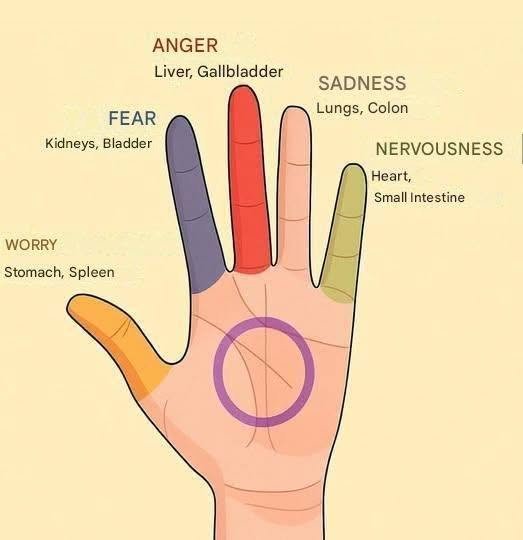
Here’s a detailed overview.
What is Jin Shin Jyutsu?
Jin Shin Jyutsu is a Japanese healing art developed in the early 20th century by Jiro Murai. Practitioners believe that energy flows through pathways in the body and that gently holding specific fingers or body points can help restore balance, reduce stress, and support physical and emotional well-being.
Unlike massage, it typically involves simply holding a finger with the opposite hand for several minutes while breathing slowly.
Finger-to-Organ Correspondence
According to Jin Shin Jyutsu, each finger is associated with specific organs and emotional states.
| Finger | Associated Organs | Emotional Association | Common Physical Symptoms |
|---|---|---|---|
| Thumb | Stomach, Spleen | Worry, anxiety | Digestive issues, headaches |
| Index finger | Kidneys, Bladder | Fear | Back pain, urinary discomfort |
| Middle finger | Liver, Gallbladder | Anger, frustration | Muscle tension, headaches, menstrual discomfort |
| Ring finger | Lungs, Large Intestine | Sadness, grief | Breathing issues, skin problems |
| Little finger | Heart, Small Intestine | Stress, insecurity | Heart palpitations, sore throat, fatigue |
How to Practice
- Sit comfortably.
- Relax your shoulders.
- Hold one finger gently with the opposite hand.
- Apply only light pressure.
- Breathe slowly and deeply.
- Hold for about 3–5 minutes, or longer if comfortable.
- Repeat with other fingers if desired.
Some practitioners recommend practicing both hands.
Example Routine
For stress and anxiety
- Hold the thumb for 3–5 minutes.
- Breathe deeply.
- Switch to the other thumb.
For anger or frustration
- Hold the middle finger.
- Take slow breaths.
- Continue for several minutes.
For grief
- Hold the ring finger while focusing on slow, relaxed breathing.
Claimed Benefits
Practitioners report that finger holding may help:
- Reduce stress
- Promote relaxation
- Improve sleep
- Ease tension
- Support emotional balance
- Complement meditation
- Increase body awareness
The relaxation response itself can have measurable benefits, such as lowering heart rate and reducing perceived stress.
What Does Science Say?
Research on Jin Shin Jyutsu is limited.
Some small studies suggest it may:
- Reduce anxiety
- Improve relaxation
- Enhance quality of life in some people
However:
- There is no strong scientific evidence that holding specific fingers directly affects internal organs.
- Claims about treating diseases or correcting organ dysfunction have not been established by high-quality clinical research.
The benefits people experience are more likely related to:
- Mindful breathing
- Relaxation
- Stress reduction
- Gentle touch
- Focused attention
Safety
This practice is generally considered safe because it is non-invasive. However:
- It should not replace medical treatment for serious illnesses.
- Persistent pain, organ-related symptoms, fever, chest pain, or difficulty breathing should be evaluated by a healthcare professional.
A Simple 15-Minute Routine
- Thumb: 3 minutes
- Index finger: 3 minutes
- Middle finger: 3 minutes
- Ring finger: 3 minutes
- Little finger: 3 minutes
Sit quietly, breathe slowly through the nose, and focus on relaxing while gently holding each finger.
Bottom line
Japanese finger therapy, particularly Jin Shin Jyutsu, is a gentle self-care practice that many people find calming and helpful for stress management. The traditional associations between fingers, organs, and emotions are part of this healing system, but they are not supported by strong scientific evidence as direct physiological connections. Used alongside—not instead of—appropriate medical care, it can be a relaxing mindfulness practice.