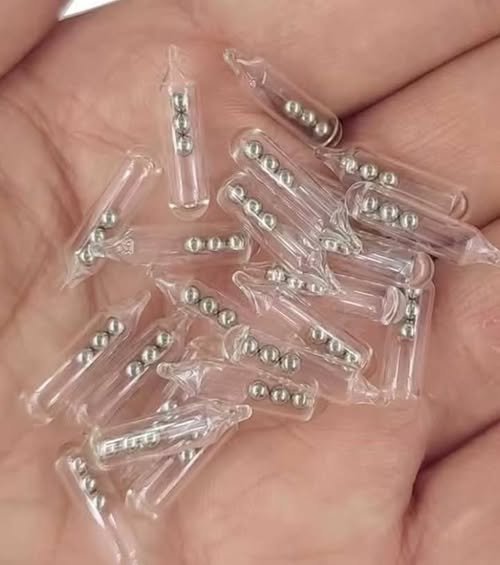
A few important possibilities:
1. Laboratory glass tubing
If they’re simple, straight tubes—especially transparent, narrow tubes with one end closed—they could be laboratory glassware.
Common examples include:
- Test tubes — small samples of liquids or solids can be placed in them. The Smithsonian describes test tubes as one of the most common types of laboratory ware, historically available in many sizes.
- Capillary tubes — extremely thin glass tubes used for tiny quantities of liquid, including some medical and laboratory procedures.
- Reaction tubes — small tubes used for chemical reactions.
- Glass transfer tubing — used to move gases or liquids between pieces of apparatus.
- Specialized analytical tubes — some have markings, bulbs, bends, or unusual internal structures.
Laboratory glass tubing has been used for centuries, and historical scientific collections contain some remarkably strange-looking pieces. The Science Museum, for example, has specialized U-shaped chemical tubing containing bulbs and internal tubes.
2. Medical or pharmaceutical tubes
They could also be associated with medicine.
Very thin glass capillary tubes, for example, have been used to collect small quantities of blood. OSHA, NIOSH and FDA have specifically warned that these can be hazardous because they are extremely fragile and can cause penetrating injuries if broken.
Older pharmaceutical equipment also made extensive use of glass. Historical apothecaries used glass containers for oils, tinctures, syrups, crude drugs and other substances.
If your uncle was interested in chemistry, medicine, microscopy, photography, electronics, antiques, or collecting scientific equipment, that could explain a drawer full of miscellaneous glass pieces.
3. They could be drug-related—but don’t jump to that conclusion
Some small glass tubes are associated with drug use, including certain glass pipes or tubes. Government drug-awareness material specifically lists glass pipes and tubes among objects that can be associated with drug paraphernalia.
However, a glass tube by itself tells us essentially nothing about whether drugs were involved. Ordinary scientific and medical glassware can look very similar.
Things that would make me more interested in identifying them include:
- a bowl or bulb at one end
- a side opening
- a mouthpiece-like end
- unusual bends
- colored or frosted glass
- printed graduations/numbers
- manufacturer’s markings
- rubber, cork, or plastic pieces
- metal clips or wires
- one end permanently sealed
- extremely tiny internal diameter
- several identical pieces in the bag
- residue or discoloration inside
4. Don’t experiment with them yet
Since you don’t know their history, don’t heat them, smell them, taste anything inside, scrape out residue, or try to connect them to other equipment.
Old laboratory glass can have contained chemicals, and glass itself can become surprisingly dangerous when cracked or weakened. Laboratory safety guidance recommends using glassware without cracks or chips and taking particular precautions with glass tubing because it can break and cause serious cuts.
If there is visible unknown residue inside, I’d leave it alone rather than trying to clean it.
I can probably identify them for you
A photograph would be much more useful than a description. Put several of the tubes next to a ruler or coin for scale and take:
- one photo of the entire bag,
- one photo of several tubes laid out,
- close-ups of both ends,
- close-ups of any bends, bulbs, markings, labels, or residue.
If there are different types, photograph each type separately.
Upload the photos here, and I can go tube-by-tube and tell you what each one most likely is, what it was historically/currently used for, whether it has a medical/laboratory/industrial purpose, and what clues led to the identification.