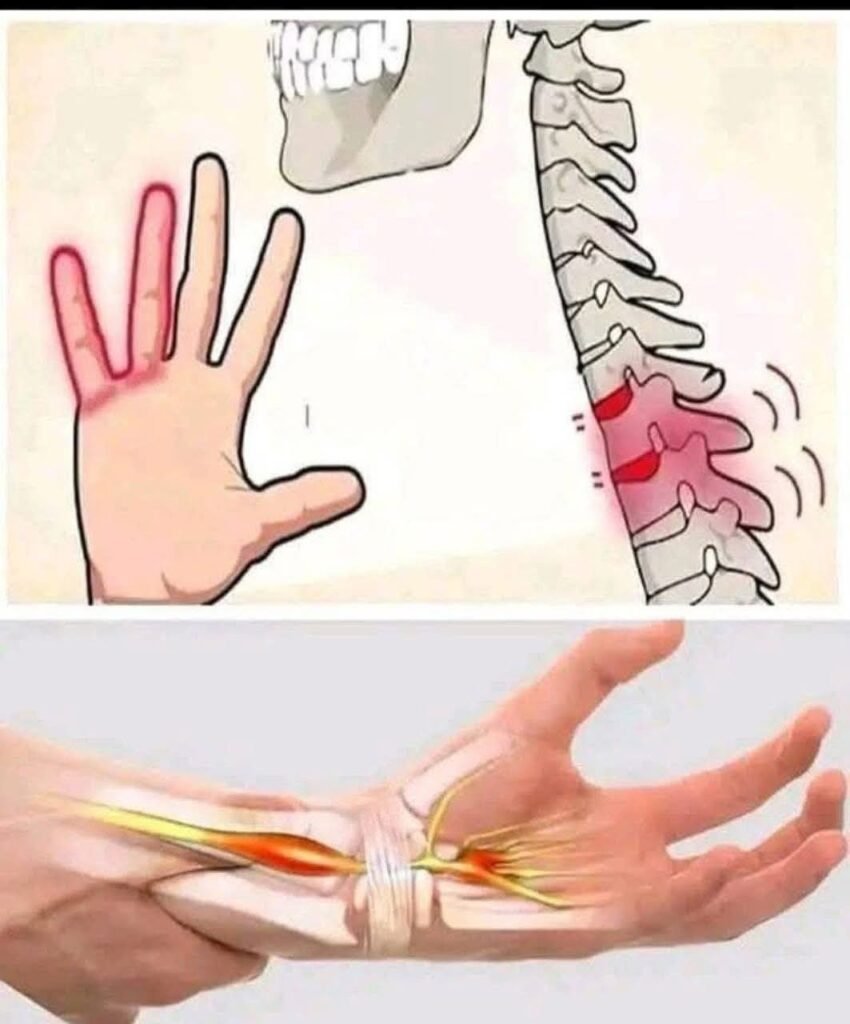
If your hand “falls asleep” (feels numb, tingles, or has a pins-and-needles sensation), it is usually caused by temporary pressure on a nerve or reduced blood flow. In many cases, it’s harmless and goes away within a few minutes after you change position.
Common Causes
1. Pressure on a Nerve
This is the most common reason.
Examples:
Sleeping on your arm.
Leaning on your elbow for a long time.
Holding your wrist or arm in an awkward position.
The pressure temporarily interferes with nerve signals, causing numbness and tingling.
2. Carpal Tunnel Syndrome
This occurs when the median nerve is compressed at the wrist.
Symptoms may include:
Numbness or tingling in the thumb, index, middle, and part of the ring finger.
Symptoms often worse at night.
Weak grip strength.
3. Pinched Nerve in the Neck
A nerve can become compressed where it exits the spine.
Possible symptoms:
Numbness in the hand or arm.
Neck pain.
Shoulder or arm pain.
Muscle weakness.
4. Poor Circulation
Reduced blood flow can contribute to numbness.
Possible causes:
Tight clothing or jewelry.
Certain blood vessel disorders.
Prolonged pressure on an arm.
5. Vitamin Deficiencies
Deficiencies, especially of:
Vitamin B12
Vitamin B6
Vitamin E
can affect nerve function and lead to numbness or tingling.
6. Medical Conditions
Persistent or recurring numbness may be associated with conditions such as:
Type 2 Diabetes
Multiple Sclerosis
Hypothyroidism
Peripheral neuropathy (nerve damage)
When to Seek Medical Care
You should seek medical attention if:
The numbness happens frequently.
Symptoms persist for hours or days.
You have weakness in the hand or arm.
You have difficulty speaking, walking, or seeing.
Numbness affects one side of the body suddenly.
Sudden numbness, especially with facial drooping, speech problems, or weakness, can be a sign of a medical emergency such as a stroke and requires immediate medical attention.
What You Can Do
If it’s due to temporary pressure:
Change position.
Stretch your hand, wrist, and arm.
Gently move your fingers.
Avoid leaning on the affected arm.
Bottom Line
An occasional hand “falling asleep” is usually caused by temporary nerve compression and is not dangerous. However, frequent, persistent, or worsening numbness—especially when accompanied by weakness, pain, or other neurological symptoms—should be evaluated by a healthcare professional.