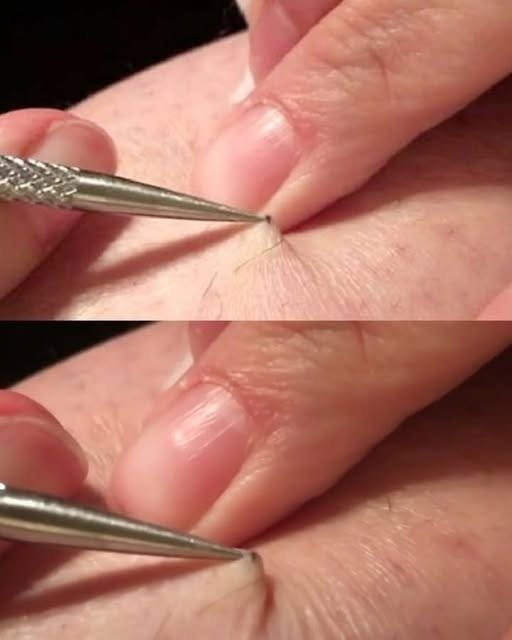
The headline you quoted sounds like a viral medical/parasite story, but I couldn’t verify that exact wording or identify the man with confidence from reliable sources. There are, however, two real medical conditions that closely match the description, and they are quite different.
1. The “black spot” may have been a sand flea
One particularly striking possibility is tungiasis, an infestation caused by the female sand flea (Tunga penetrans).
The flea can burrow into the skin—usually around the feet and toes, although other areas can be affected. Initially, a person may notice a tiny, itchy or painful spot. As the flea becomes embedded, a dark central point can develop.
A documented case involved a young man who developed a 1-mm, itchy black spot on his heel after traveling in Peru. Over several weeks it enlarged into a nodule with a black center. When doctors opened the lesion, they found the parasite along with eggs and fecal material inside.
That is probably the kind of discovery that inspires sensational headlines such as “He picked off a black spot and couldn’t believe what came out.”
The flea doesn’t simply sit on top of the skin. The female flea penetrates the epidermis and enlarges while feeding on blood, eventually producing hundreds of eggs. After its reproductive cycle, it dies and is eventually expelled or removed.
2. Another possibility: a tick or tick-borne “black spot”
A black area on the skin can also be an eschar, essentially a dark scab of dead tissue that can form at the site of an arthropod bite.
For example, people infected with African tick-bite fever can develop a characteristic black eschar at the bite site. Medical literature describes this as tache noire (“black spot”).
Importantly, this isn’t necessarily something alive that can simply be “peeled off.” The black material can represent necrotic tissue, and the underlying infection may require medical treatment.
3. It could also be something much less dramatic
A black spot that comes off when someone scratches or picks it is not automatically a parasite.
It could be:
- a scab from a minor injury
- dried blood
- a wart or keratin plug
- an embedded foreign body
- a tick
- a fungal or bacterial skin problem
- occasionally, abnormal pigmented tissue
There is also a rare condition called black-spot poison ivy dermatitis. In this condition, poison-ivy resin can oxidize into a black, lacquer-like substance on the skin. It can look extremely alarming but isn’t a parasite.
What about melanoma?
This is worth emphasizing because viral stories can cause unnecessary panic.
A melanoma generally doesn’t behave like a little object that can simply be picked off the skin. If a dark lesion appears to come away, that makes melanoma less likely, but it doesn’t establish what the lesion was. A persistent, changing, bleeding, or irregular dark spot should be examined by a dermatologist rather than repeatedly picked at.
The American Academy of Dermatology notes that melanoma can appear as a dark spot and recommends professional evaluation of suspicious lesions.
So what was actually “removed”?
If the story you’re referring to specifically says that the man picked at a black spot on his leg and removed something resembling a tiny organism, the most plausible medical explanation from the available documented cases is an embedded arthropod such as a sand flea or tick, rather than a piece of ordinary skin.
But I would not claim that this particular viral story was a sand flea case without seeing the original article/video. The wording you gave doesn’t provide enough information to identify the original incident reliably.
If you send me the headline, photo, video, or link to the story, I can identify exactly what the black object was and explain what was happening underneath his skin, how it got there, how it feeds/reproduces, and whether it was dangerous, in detail.