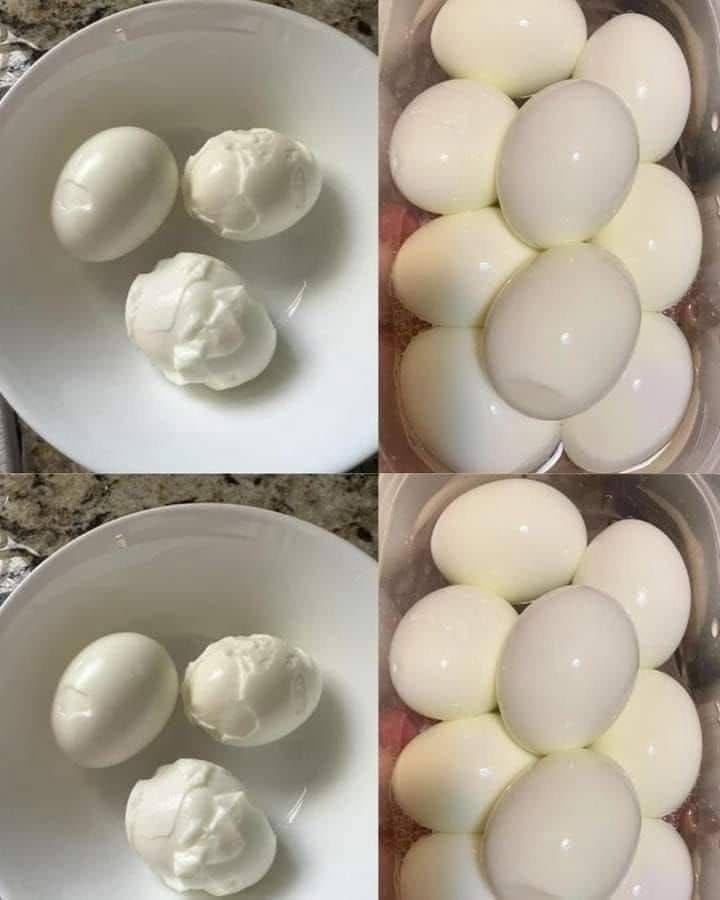
Here are the methods that have the strongest evidence and the reasons they help:
- Use slightly older eggs (about 7–10 days old) if possible. As eggs age, the albumen becomes less acidic and the inner membrane separates more easily from the shell.
- Lower eggs into already boiling water rather than starting them in cold water. For many people, this causes the proteins near the shell to set more quickly, making peeling easier.
- Cool the eggs immediately in an ice bath for 5–10 minutes. Rapid cooling helps the egg contract slightly and stops cooking, which often makes peeling easier.
- Crack the shell all over before peeling, then peel under running water or in a bowl of water. Water can slip under the membrane and help separate it from the egg.
What about the viral “hack”?
There are several different hacks that circulate online:
- Adding baking soda to the water.
- Adding vinegar to the water.
- Shaking the egg in a jar with a little water.
- Blowing the egg out of the shell.
- Steaming instead of boiling.
Some of these can work in certain situations, but none is a universal solution. For example:
- Vinegar mainly helps if a shell cracks during cooking by causing leaking egg white to coagulate faster; it doesn’t reliably improve peeling.
- Baking soda raises the water’s pH, which may help a little, but studies and kitchen tests generally find egg age and cooking method have a much larger effect.
- Steaming is actually one of the most consistently successful alternatives because it cooks the outer layer quickly and often results in easier peeling.
If you’re referring to a specific hack that “everyone knows”—for example, tapping the egg and rolling it, adding vinegar, using an air fryer, or shaking it in a container—tell me which one you mean, and I can explain in detail how it works, whether it actually does, and what the evidence says.