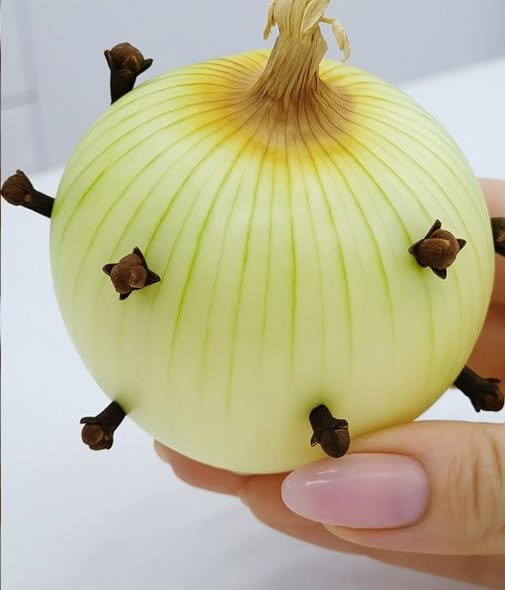
Absolutely. The French technique you’re referring to is called oignon piqué (literally, a “pricked/studded onion”). It’s a classic way of flavoring soups, stocks, sauces, and stews.
🧅 Why do French cooks put cloves in an onion?
The basic method is simple: peel an onion, then push whole cloves into it. The clove-studded onion is simmered in a liquid and removed before serving.
The technique is especially associated with French preparations such as bouillon, stocks, sauces, and béchamel.
1. It gives the dish a deeper aroma
Cloves contain intensely aromatic compounds, particularly eugenol, which produces their characteristic warm, slightly sweet, spicy fragrance.
When the onion gently simmers, the clove releases its aroma into the cooking liquid. Because the onion itself also contributes sweetness and savory flavor, the combination is much more complex than simply adding powdered spices.
2. It keeps the cloves under control
This is one of the cleverest parts of the technique.
Instead of scattering cloves throughout a pot—where someone might bite directly into one—the cloves are anchored in the onion.
You get the flavor without having to hunt for individual cloves afterward.
Think of the onion as a natural spice holder.
3. The onion adds sweetness while the clove adds spice
Onions gradually release sugars and savory compounds as they cook.
The clove contributes a warm, slightly medicinal, almost peppery character. Together they create a balanced background flavor rather than making the dish taste obviously like “cloves.”
This is why the technique works particularly well in long-simmered dishes.
🇫🇷 Where is it traditionally used?
A clove-studded onion can be used in preparations such as:
- Béchamel sauce — traditionally infused with onion, bay leaf, and clove before the milk is incorporated.
- French stocks and broths — for subtle aromatic depth.
- Pot-au-feu — the classic French boiled beef dish.
- Soups and stews — especially recipes where the cooking liquid is an important part of the final dish.
- Sauces — when a subtle aromatic infusion is wanted without visible spices.
👵 Why your grandmother’s method is actually clever
There’s a practical reason older cooks often used techniques like this: whole aromatics are easier to remove and control than ground spices.
If you add ground clove to a soup, its flavor can quickly become overpowering and it remains in the finished liquid.
With a studded onion, the cook can:
Add → infuse → remove.
The onion and cloves essentially act like a homemade bouquet garni component.
🧅 How to do it properly
For a medium onion:
- Peel the onion but leave it whole.
- Take about 4–6 whole cloves.
- Push the cloves into the onion, spacing them around the surface.
- Put the onion into your soup, stock, sauce, or stew.
- Simmer gently.
- Remove the onion and cloves before serving if the recipe calls for it.
Tip: Don’t go overboard with cloves. They are extraordinarily potent. A few whole cloves can perfume an entire pot.
The interesting part: it’s not just a “French trick”
Similar combinations of onion + clove appear in several European culinary traditions. The broader idea is ancient: use whole spices and aromatic vegetables to perfume a cooking liquid, then remove them before eating.
So if your grandmother has always done this, she wasn’t just adding a random spice to an onion. She’s using a very old infusion technique that gives the cook much better control over flavor.
In short: the onion provides sweetness and savory depth; the cloves provide warm aromatic complexity; and putting the cloves inside the onion makes the whole thing easy to control and remove. That’s the little trick that makes the technique so useful.