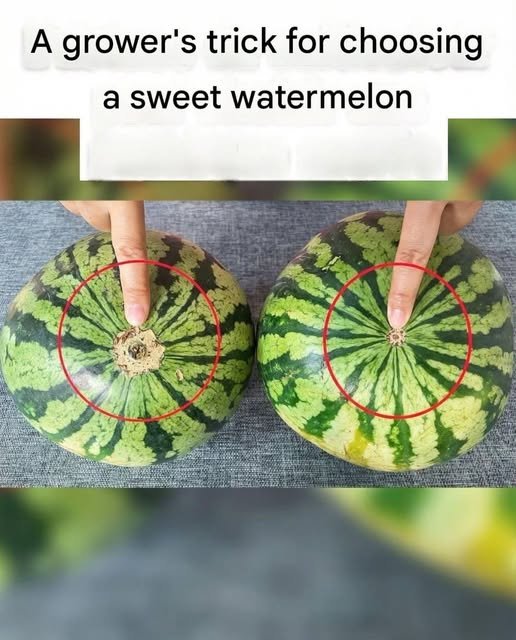
If you want to pick a sweet, juicy watermelon every time, look beyond the size and colour. The sweetest watermelons usually show several visual clues that tell you they had enough time to ripen naturally.
🍉 1. Look for the “field spot” (the yellow patch)
- The field spot is the area where the watermelon rested on the ground while growing.
- A large, creamy yellow or golden-yellow patch is a strong sign of ripeness.
- Avoid melons with a white, pale-green, or tiny field spot — they may have been picked too early.
- The deeper the yellow colour, the longer the melon likely stayed on the vine developing sweetness.
🍉 2. Check the shape: round and symmetrical wins
- Choose a watermelon with a uniform, even shape.
- A good melon should look balanced without strange bumps, dents, or flat sides.
- Irregular shapes can indicate uneven watering or growth problems, which may affect texture.
🍉 3. Find the “sugar spots” (webbing)
Look for rough, brown, web-like lines on the skin.
- These marks are caused by tiny scars where sugar was transported through the fruit.
- More webbing often means the plant produced more sugar.
- A watermelon covered with noticeable brown webbing can be a sweeter choice.
🍉 4. Pick a dull-looking rind, not a shiny one
- A ripe watermelon usually has a slightly dull, matte skin.
- A very shiny rind can mean it is underripe.
- The green colour should look rich and consistent.
🍉 5. Check the “belly button” or blossom end
At the opposite end from the stem:
- A small, dry, slightly sunken spot is usually a good sign.
- A large, soft, or mushy area may indicate over-ripeness or damage.
🍉 6. Compare weight: heavy means juicy
Use the “heavy for its size” rule:
- Pick up two watermelons of similar size.
- Choose the heavier one.
- More weight usually means more water content and a juicier bite.
🍉 7. Give it the famous “knock test”
Tap the watermelon with your palm or knuckles.
A ripe watermelon often sounds:
- ✅ Deep and hollow: good sign of juicy flesh
- ❌ Dull or flat: may be overripe or lacking freshness
The sound test is useful, but it works best when combined with other signs.
🍉 8. Check the stem (if attached)
- A dry, brown stem suggests the melon had time to ripen.
- A fresh green stem can indicate it was harvested earlier.
- Many supermarket watermelons have the stem removed, so don’t rely on this alone.
🍉 9. Size isn’t everything
- Bigger does not automatically mean sweeter.
- A medium-sized watermelon with excellent ripeness signs can taste better than a huge one picked too early.
Quick “sweet watermelon checklist”
Before buying, look for:
✅ Large creamy-yellow field spot
✅ Heavy for its size
✅ Dull dark-green rind
✅ Symmetrical shape
✅ Brown sugar webbing
✅ Dry stem (if available)
✅ Deep hollow sound when tapped
Mistakes to avoid
❌ Choosing the brightest green melon only
❌ Picking the biggest one in the pile
❌ Buying one with soft bruised spots
❌ Ignoring the field spot
With these clues, you can usually avoid bland, watery watermelons and choose one that is crisp, sweet, and full of flavour.