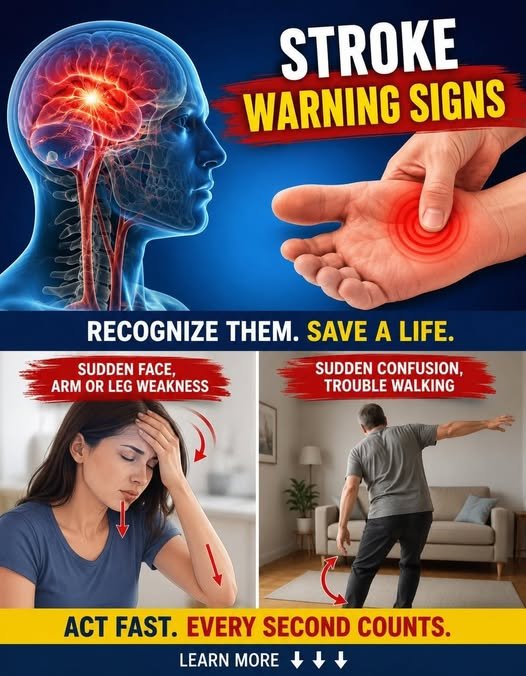
Recognizing Early Stroke Warning Signs: Why Every Minute Matters
Recognizing the warning signs of a stroke early can save a life and reduce the risk of permanent disability. A stroke occurs when blood flow to part of the brain is blocked by a clot or when a blood vessel in the brain ruptures. Without enough oxygen, brain cells can begin dying within minutes.
Stroke is therefore a medical emergency—not something to wait and watch at home. If stroke symptoms appear, call 911 immediately, even if the symptoms improve or disappear.
The B.E. F.A.S.T. warning signs
The American Stroke Association recommends B.E. F.A.S.T. as an easy way to remember important stroke symptoms.
B — Balance loss
Look for a sudden loss of balance or coordination. A person may suddenly have difficulty walking, become very dizzy, or appear unable to stand normally.
E — Eye or vision changes
Sudden changes in vision can be a stroke warning sign. This may include:
- Blurred vision
- Double vision
- Partial or complete loss of vision in one or both eyes
F — Face drooping
One side of the face may suddenly become weak or numb. Ask the person to smile. If one side of the mouth or face droops or the smile is uneven, treat it as a possible stroke.
A — Arm weakness or numbness
Ask the person to raise both arms. If one arm is weak, numb, or drifts downward, this can be a stroke warning sign. Weakness may also occur in a leg or on one entire side of the body.
S — Speech difficulty
A person may suddenly:
- Slur their words
- Have difficulty speaking
- Be unable to find the right words
- Have trouble understanding what others are saying
- Say something that does not make sense
Ask them to repeat a simple sentence. New difficulty speaking or understanding should be treated as an emergency.
T — Time to call 911
If even one of these symptoms occurs suddenly, call 911 immediately. Do not wait to see whether the person gets better. Note the time the symptoms began—or the last time the person was known to be normal—because this information can be important to the medical team.
Other important warning signs
Not every stroke looks exactly the same. Other symptoms that can occur suddenly include:
- Numbness or weakness of the face, arm, or leg, particularly on one side
- Sudden confusion
- Difficulty speaking or understanding speech
- Sudden trouble seeing
- Sudden difficulty walking
- Dizziness or loss of coordination
- A sudden, severe headache with no known cause
A person does not need to have all of these symptoms. One sudden, unexplained symptom can be enough to warrant an emergency call.
What should you do if you suspect a stroke?
1. Call 911 immediately.
Do not drive the person yourself if an ambulance is available. Emergency medical personnel can begin evaluation and care on the way to the hospital and can alert the hospital that a possible stroke patient is coming.
2. Record when the symptoms started.
Tell emergency responders when the symptoms were first noticed. If the person woke up with symptoms, tell responders when the person was last known to be normal.
3. Do not wait for symptoms to disappear.
Some stroke symptoms can temporarily improve. This may be a transient ischemic attack (TIA), sometimes called a “warning stroke.” A TIA can have the same symptoms as a stroke and still requires urgent medical evaluation because it can signal a significant risk of a future stroke.
4. Don’t assume it’s something minor.
Sudden dizziness, confusion, vision problems, or unusual speech may have causes other than stroke, but it is safer to have emergency professionals evaluate the situation than to delay treatment.
Why acting quickly matters
Stroke treatment is highly time-sensitive. Some people with an ischemic stroke may be eligible for clot-dissolving medications, while certain patients with large-vessel blockages may benefit from a procedure called mechanical thrombectomy to remove the clot. Eligibility depends on the type of stroke, when symptoms began, brain and blood-vessel imaging, and other medical factors.
The American Stroke Association emphasizes that time lost is brain lost. Faster recognition and treatment can improve the chances of survival and recovery and can reduce the likelihood of long-term disability.
An easy message to remember
B.E. F.A.S.T.:
B — Balance loss
E — Eye/vision changes
F — Face drooping
A — Arm weakness
S — Speech difficulty
T — Time to call 911
If you see these signs suddenly, don’t wait—call 911.
For additional educational material, the American Stroke Association’s B.E. F.A.S.T. resources provide printable information that can be shared with family, coworkers, schools, and community groups.
If you or someone near you is experiencing possible stroke symptoms right now, call 911 immediately.