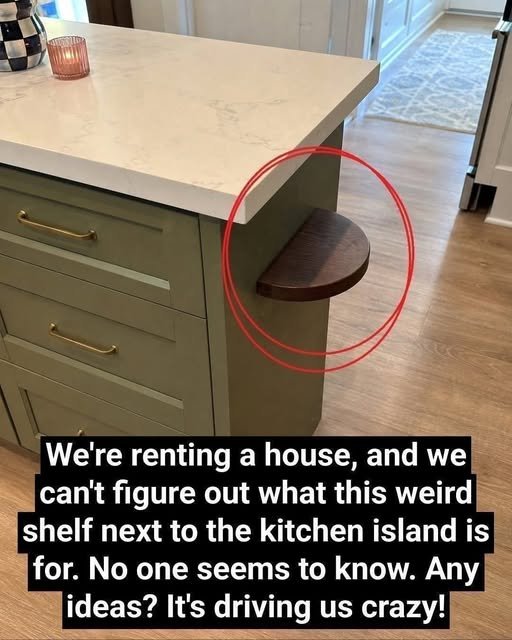
If you mean the article titled “The Mystery of the Little Ledge: What That Small Kitchen Island Shelf Is Actually For (And How to Love It)”, the basic idea is that the little ledge is usually intentional—but it isn’t meant to be a mini countertop or a seat. It is generally a light-duty landing/display ledge, and its exact purpose depends on how the island was designed.
The little kitchen-island ledge, explained
1. What is it actually for?
Think of it as a “pause spot.”
A normal kitchen island has a large working surface for chopping, preparing food, serving, etc. The small shelf on the side doesn’t have enough depth to do those jobs comfortably. Instead, it gives you a tiny extra surface for things that need somewhere to go temporarily.
For example:
- ☕ A coffee mug while you’re cooking
- 📱 Your phone while following a recipe
- 📖 A cookbook or tablet
- 🥂 A drink when you’re entertaining
- 🔑 Keys or sunglasses
- 🌿 A small plant or vase
- 🍋 A small decorative bowl
- 🍽️ A napkin or small appetizer plate
The important distinction is that it is a landing area, not serious storage.
2. Why would a designer put such a tiny shelf there?
This is where the design aspect becomes important.
Kitchen islands can have very large, uninterrupted side panels. Without anything on them, the end of an island can look like a big rectangular block of cabinetry.
A small shelf breaks up that blank surface.
If the shelf is curved or rounded, it does even more: it softens the hard geometry of the kitchen. Kitchens naturally contain lots of straight lines—cabinet doors, countertops, appliances, walls, and corners. A curved ledge introduces a little visual softness.
If the ledge uses the same stone or wood as the countertop, it also visually connects the side of the island to the main worktop. So even when you aren’t putting anything on it, the shelf itself is part of the decoration.
3. It’s not necessarily a breakfast bar
This is an easy thing to confuse.
A genuine island seating extension is normally designed with enough horizontal depth and knee space for a person to sit comfortably. A breakfast-bar overhang, for example, extends beyond the island specifically to accommodate stools.
The tiny side ledge is different.
If yours is only a few inches deep and there’s no room underneath for your knees, don’t treat it as seating.
Even if it looks sturdy because it’s made from quartz, granite, marble, or thick wood, the material doesn’t tell you how much weight the mounting can safely support.
4. What makes it particularly useful when you’re entertaining?
This is actually one of the nicest uses.
Imagine you’re having people over and everyone is standing around the kitchen island.
The main countertop is already occupied by:
- food,
- cutting boards,
- serving dishes,
- utensils,
- napkins,
- drinks.
Someone can use the little ledge as a personal landing spot for a glass or small plate, keeping the main preparation area less crowded.
So rather than thinking:
“Why did someone build this useless little shelf?”
think:
“It’s a tiny piece of counter space specifically for the things that don’t deserve the main counter.”
That’s a surprisingly useful distinction.
5. How to style it without making it look cluttered
This is probably the biggest secret to loving the ledge.
Don’t try to maximize it.
Because the shelf is small, putting six or seven objects on it will usually make the entire island look cluttered.
Instead, try one intentional object.
Option A: The little vase
Put a small vase with one or two flowers on it.
This works particularly well if the shelf is visible from the living room because it turns an otherwise unexplained architectural feature into a deliberate decorative moment.
Option B: A small bowl
A shallow ceramic bowl can hold:
- lemons,
- limes,
- garlic,
- wrapped candies,
- keys,
- or nothing at all.
A beautiful empty bowl can actually look better than a bowl overflowing with random objects.
Option C: The cookbook
If you’re someone who actually cooks from physical cookbooks, one attractive cookbook can lean against the island.
This makes the ledge feel functional without turning it into a bookshelf.
Option D: A small plant
A compact plant can soften the kitchen and make the island feel less industrial.
Just make sure the pot isn’t so large that it sticks into the walkway.
Option E: Keep it completely empty
Honestly, this may be the best choice.
If the island has beautiful stone, wood grain, or a particularly attractive curved detail, leaving the ledge empty lets the architecture do the work.
Empty doesn’t mean unused. It can simply mean the shelf is being appreciated as part of the design.
6. What should you NOT put on it?
This is important because a little ledge can look stronger than it actually is.
Unless the manufacturer/cabinetmaker specifically designed it for heavier loads, avoid:
- ❌ Sitting on it
- ❌ Standing on it
- ❌ Letting children climb on it
- ❌ Heavy kitchen appliances
- ❌ A large stand mixer
- ❌ Heavy stacks of dishes
- ❌ Large casserole dishes
- ❌ Hot cookware
- ❌ Anything that could easily fall into a walkway
The attachment method matters just as much as the material. A stone shelf that looks extremely solid may still have limited support underneath.
7. There’s another practical issue: the walkway
If your little ledge sticks into a busy passage around the island, be careful about what you put there.
A beautiful vase may look wonderful—but if everyone walking past keeps bumping their hip into it, you’ve created a hazard rather than a design feature.
For a ledge near a traffic path, low-profile and lightweight is best.
A shallow bowl or nothing at all is often better than a tall vase or fragile sculpture.
8. The easiest way to think about it
Here’s the simplest mental model:
| Kitchen feature | What it’s really for |
|---|---|
| Main countertop | Cooking/preparation |
| Island overhang | Seating |
| Deep cabinet | Storage |
| Open island shelf | Storage/display |
| Tiny side ledge | Light-duty landing + decoration |
So the little shelf isn’t necessarily supposed to have one highly specialized purpose.
It’s more like a micro-surface.
You can put something down for a moment, display something attractive, use it while entertaining, or simply let it make the island look more finished.
9. How to “love” the ledge
The trick is to stop asking:
“What am I supposed to store here?”
and instead ask:
“What small moment in my kitchen could happen here?”
Morning coffee? → Put your mug there.
Cooking? → Put your phone/tablet there.
Dinner party? → Put a drink there.
Coming home? → Temporary spot for your keys.
Decorating? → Small plant or vase.
Minimalist kitchen? → Leave it empty.
That’s why the ledge can actually be a nice design feature. It doesn’t need to perform a major job. It provides a tiny bit of convenience while making an otherwise plain island end more interesting.
One caveat: there isn’t a universal technical name or single purpose for every small island ledge. The article’s explanation applies to the common decorative/light-duty type; some similarly shaped ledges may have been specifically designed for serving, seating, storage, or another function. The construction and dimensions of your particular island are what determine its safe use.