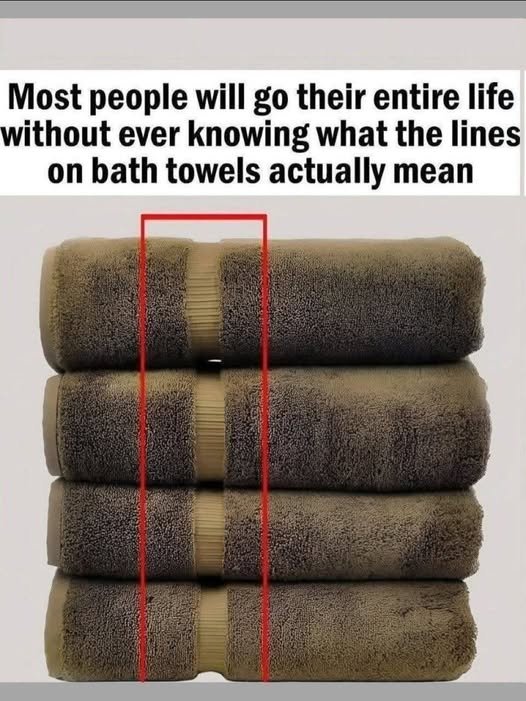
The “Secret Code” on Bath Towels: What Those Lines Actually Mean
Those horizontal lines or bands you see near the ends of many bath towels are not a secret code, a hygiene marker, or a measurement system. They are usually a textile feature called a dobby border (and sometimes a related flat-woven or “cam” border).
The interesting part is that they are both decorative and functional. Their main practical role is to give the towel more structure and help reduce fraying and distortion over repeated washing.
1. What exactly are the lines?
Look closely at a typical terry bath towel:
- The main body is fluffy and looped.
- Near one or both short ends is a flatter strip.
- That strip may contain one stripe, several stripes, geometric patterns, or a relatively plain woven band.
- It is usually located just above the hem rather than directly on the outermost edge.
That woven strip is commonly called a dobby border. Good Housekeeping’s textile expert Emma Seymour describes it as a woven strip near the towel’s ends that provides additional structure.
The name “dobby” comes from the type of weaving mechanism used to produce small, repeated woven patterns. In other words, the lines are woven into the towel, rather than simply being printed on afterward.
2. Why does the border feel different from the rest of the towel?
This is one of the biggest clues to its purpose.
The fluffy part of a bath towel is terry cloth. Terry fabric uses loops of yarn that stick up from the surface. Those loops create lots of surface area and help the towel hold water.
The border, by contrast, is generally more tightly and flatly woven. It doesn’t have the same fluffy terry loops.
So when you run your hand over the towel, you get:
Soft terry loops → flat woven band → soft terry loops
That difference isn’t an accident. The flat section provides a more stable area around the towel’s ends.
It also explains why the stripe can feel slightly less absorbent than the rest of the towel. The stripe isn’t supposed to be the primary water-absorbing portion. The terry-looped body does most of that work.
3. The biggest reason: structural reinforcement
Imagine a towel as a large rectangle made primarily of thousands of soft loops.
Those loops are excellent for absorbing water, but they’re not the ideal construction for maintaining a perfectly stable edge through years of:
- soaking,
- pulling,
- twisting,
- washing,
- tumbling,
- heating,
- folding, and
- unfolding.
The woven border provides a more stable transition around the ends.
Think of it somewhat like reinforcement around the edge of a piece of fabric.
The border helps the towel:
- maintain its rectangular shape,
- resist distortion,
- reduce edge movement,
- reduce fraying,
- and generally withstand repeated laundering better.
Textile experts specifically identify maintaining shape and reducing fraying as important purposes of the dobby border.
4. Why towels need this reinforcement
Bath towels get abused more than we realize.
A towel might be washed dozens or hundreds of times during its lifetime. Each washing cycle subjects the fabric to mechanical movement and friction. Drying adds additional stress, particularly when high heat is used.
Over time, an unreinforced edge can begin to:
fray → loosen → distort → unravel
The tightly woven border provides additional stability in an area that experiences a lot of stress.
This is why calling it merely a “decoration” doesn’t tell the whole story.
It looks decorative, but it can also have a genuine construction benefit.
5. Does the number of lines mean something?
Usually, no.
This is where the idea of a “secret code” can be misleading.
You might see:
- one thin line,
- two lines,
- several parallel lines,
- a wide patterned band,
- geometric shapes,
- or a completely plain flat border.
There isn’t a universal industry system where:
1 stripe = one quality level
2 stripes = premium
3 stripes = hotel quality
The design can be chosen for appearance, branding, weaving construction, or product differentiation.
So don’t look at the number of stripes and assume it tells you the towel’s GSM, cotton quality, absorbency, price category, or intended user.
Those characteristics depend on the towel’s overall construction.
6. Is the stripe a quality indicator?
Not by itself.
This is an important distinction.
A well-made dobby border can contribute to durability, but having a dobby border doesn’t automatically make a towel high quality.
When evaluating a towel, other factors are arguably more important, including:
Fiber
What is the towel made from?
Cotton is common, but different cotton types and blends can behave differently.
Fabric weight
Heavier towels often feel more substantial, although heavier doesn’t automatically mean better for every purpose.
Construction
How densely and consistently is the towel woven?
Terry-loop construction
The quality and density of the loops affect how the towel feels and performs.
Stitching and hems
Poorly constructed hems can fail even if the towel has an attractive border.
Overall durability
A towel should survive repeated washing without excessive shedding, unraveling, or deformation.
Good Housekeeping’s textile expert specifically notes that a dobby border is not a make-or-break feature when selecting a towel; towels without one can still absorb water effectively.
7. Does the border make a towel more absorbent?
This is another common misconception.
Not directly.
The fluffy terry loops are the main reason a bath towel can absorb and hold water.
Those loops create a large amount of exposed surface area. Water can be caught between and around the fibers.
The flat woven border has considerably fewer exposed loops, so it generally doesn’t absorb water in the same way.
So if you were wondering:
“Why put a less-absorbent section on an absorbent towel?”
The answer is that the border isn’t there primarily to absorb.
It’s there largely for structure, finishing, durability, and appearance.
8. Why doesn’t the whole towel have the same fluffy texture?
Because different sections of a towel have different jobs.
A simplified version looks like this:
Terry body
→ soft loops
→ high surface area
→ absorbs water
→ provides the plush feeling
Dobby/flat border
→ tighter weave
→ less fluffy
→ greater structural stability
→ helps control the edge
→ provides decorative/branding space
Hem
→ folded/sewn edge
→ finishes the fabric
→ helps prevent unraveling
So the towel isn’t necessarily made from one identical weave from end to end.
It’s a deliberately engineered combination of structures.
9. Why are the lines usually near the ends?
Placement is important.
The ends of a towel are where the fabric transitions into the hem and where the towel is most vulnerable to edge-related problems.
Putting a reinforced woven section near the ends provides a stable transition between the large terry body and the finished edge.
It also leaves the large central area covered in the absorbent terry loops.
That’s a clever compromise:
Maximum fluffy area in the middle + reinforcement where it’s useful near the edges.
The border is typically positioned a short distance from the actual hem, rather than occupying the entire end of the towel.
10. Why do some towels have two borders?
You’ll often see a towel with a band that looks like:
||||||||||||
or:
— — — — —
or a more elaborate woven pattern.
Multiple lines can simply be part of the woven design.
The manufacturer can change:
- width,
- number of stripes,
- geometric pattern,
- spacing,
- color,
- texture,
- and weave structure.
So two or three lines don’t necessarily represent different functions. They can be part of the same reinforced border.
11. Are the lines sometimes purely decorative?
Yes.
This is where the answer needs some nuance.
Not every visible stripe should be interpreted as a structural feature.
Some towel designs incorporate decorative bands primarily to:
- make the towel visually distinctive,
- coordinate with bathroom décor,
- create a premium appearance,
- provide an area for embroidery or logos,
- distinguish one product collection from another.
But even when appearance is an important reason for including the border, a properly woven border can still provide structural benefits.
Good Housekeeping’s testing information emphasizes that consumers often like the appearance of the border, but towels can function perfectly well without one.
12. What is a “cam border”?
You may also encounter the term cam border.
The terminology isn’t always used consistently across towel manufacturers and retailers, but generally the distinction is:
Dobby border:
A woven border that may contain small geometric or decorative patterns.
Cam/flat border:
A flatter, simpler woven section that may be relatively plain.
Both can serve similar structural and finishing purposes.
The important thing when looking at a towel isn’t necessarily memorizing the terminology. The practical clue is:
The fluffy terry section changes into a flatter, more tightly woven section near the edge.
That’s the feature you’re seeing.
13. Does the stripe help you fold the towel?
It can.
A flat woven border provides a convenient visual reference when folding towels.
For example, if you’re folding several towels for a linen closet, you can use the border as a visual guide to position the ends consistently.
But this is better considered a secondary convenience, not the principal reason the border exists.
The primary textile-engineering explanation is structural: it helps the towel maintain its form and resist edge damage.
14. Is there a “face” side and a “body” side?
No—those stripes don’t constitute a hygienic division.
You may encounter amusing internet theories suggesting that the border indicates where different parts of your body should be dried.
That’s not what the border was designed to do.
There isn’t a universal towel rule saying:
“This section is for your face.”
or:
“This section is for your feet.”
The border is primarily a feature of textile construction and design, not a hygiene map.
15. Does the border make the towel last forever?
Definitely not.
It can improve structural stability, but it doesn’t make a towel indestructible.
A towel’s lifespan still depends on:
- fiber quality,
- construction,
- frequency of use,
- washing frequency,
- washing temperature,
- detergent use,
- drying temperature,
- mechanical wear,
- and general care.
For example, excessive drying heat can damage cotton fibers over time and make towels feel rougher. Recent cleaning guidance recommends avoiding excessive heat and overdrying when trying to preserve towel softness and fiber condition.
16. What happens if the border starts unraveling?
That’s a useful warning sign.
If the woven band begins separating from the terry body, or the threads around the border start pulling loose, the towel is experiencing structural damage.
Don’t pull the loose thread.
Pulling it can cause additional unraveling.
Instead:
- Stop pulling at the thread.
- Examine whether the problem is limited to a small section.
- If appropriate, trim a loose thread carefully rather than pulling it.
- If the border or hem is extensively separating, repair may be worthwhile.
- If the towel is old and extensively frayed, replacement may be more practical.
17. Why do hotel towels often have these borders?
You’ll notice similar bands on many hotel, spa, gym, and commercial towels.
That makes sense because these environments subject towels to very frequent laundering and handling.
A towel used in a household might be washed periodically. A commercial towel may go through repeated cycles throughout its working life.
A reinforced, standardized construction is therefore useful.
But don’t assume:
“Border = hotel quality.”
A household towel can have one, and a high-quality towel can exist without one.
18. Does a towel without lines mean it’s cheap?
No.
This is probably the most important shopping takeaway.
A towel without a dobby border can still be:
- highly absorbent,
- durable,
- soft,
- well constructed,
- and long-lasting.
The border is only one component of the overall construction.
Good Housekeeping specifically notes that a towel without a dobby border will still perform its primary job—absorbing moisture—although it may not have exactly the same structural characteristics as a towel with one.
19. The easiest way to understand the “secret”
Think of a bath towel like a piece of clothing.
A shirt might have:
- stretchy fabric where you need movement,
- reinforced stitching where stress occurs,
- a collar with different construction,
- and hems at the edges.
The different sections aren’t mistakes or unnecessary decoration. Each part is engineered for a particular job.
The same principle applies to a towel.
The fluffy center
Job: absorb water and feel comfortable.
The flat woven border
Job: provide structural stability, reduce fraying, and add visual finishing.
The outer hem
Job: finish the edge and help prevent unraveling.
So those mysterious lines are essentially a small piece of textile engineering hiding in plain sight.
20. What the lines DON’T tell you
Don’t use the stripes to determine:
❌ how many times the towel has been washed
❌ whether it’s antibacterial
❌ which part of your body to dry
❌ whether it’s automatically premium quality
❌ whether it’s made from Egyptian cotton
❌ the towel’s GSM
❌ how absorbent the entire towel will be
❌ whether the towel is new or old
❌ whether it belongs to a particular hotel
❌ a universal “quality rating”
There is no universal secret code represented by the number of stripes.
21. What you SHOULD look for when buying a towel
If you’re shopping for good bath towels, pay more attention to:
1. Fiber composition
Look at what the towel is actually made from.
2. Construction
Check whether the loops and edges look consistent.
3. Weight and thickness
A heavier towel can feel luxurious, but very heavy towels can take longer to dry.
4. Absorbency
A plush appearance doesn’t automatically guarantee excellent performance.
5. Stitching
Inspect the hems and corners for loose threads.
6. Border construction
If there’s a dobby border, it should be securely woven rather than excessively loose or stiff.
7. Care requirements
A towel requiring unusually delicate care may not be ideal for everyday household use.
8. Your drying environment
If your bathroom stays humid, a moderately weighted, quick-drying towel may be more practical than an extremely thick one.
22. The bottom line
Those lines on your bath towel aren’t a mysterious manufacturer code.
They’re usually a woven dobby border, and they serve several purposes:
🧵 Structural:
They add stability near the ends of the towel.
🛡️ Protective:
They help reduce fraying and deformation.
📐 Shape control:
They help the towel maintain its rectangular form through repeated use and laundering.
🎨 Decorative:
They give the towel a finished, recognizable appearance.
🏷️ Branding:
The flat area can also provide a useful location for decorative patterns or embroidery.
🧺 Folding:
The border can provide a convenient visual reference when folding.
Most importantly, the lines aren’t what makes the towel absorbent. The terry loops in the main body do most of that work. And a towel without a dobby border isn’t necessarily inferior.
So the next time you grab a bath towel and see those stripes, you’re looking at something much less mysterious—but arguably more interesting: a small piece of textile engineering designed to make a soft, heavily used piece of fabric hold together better.