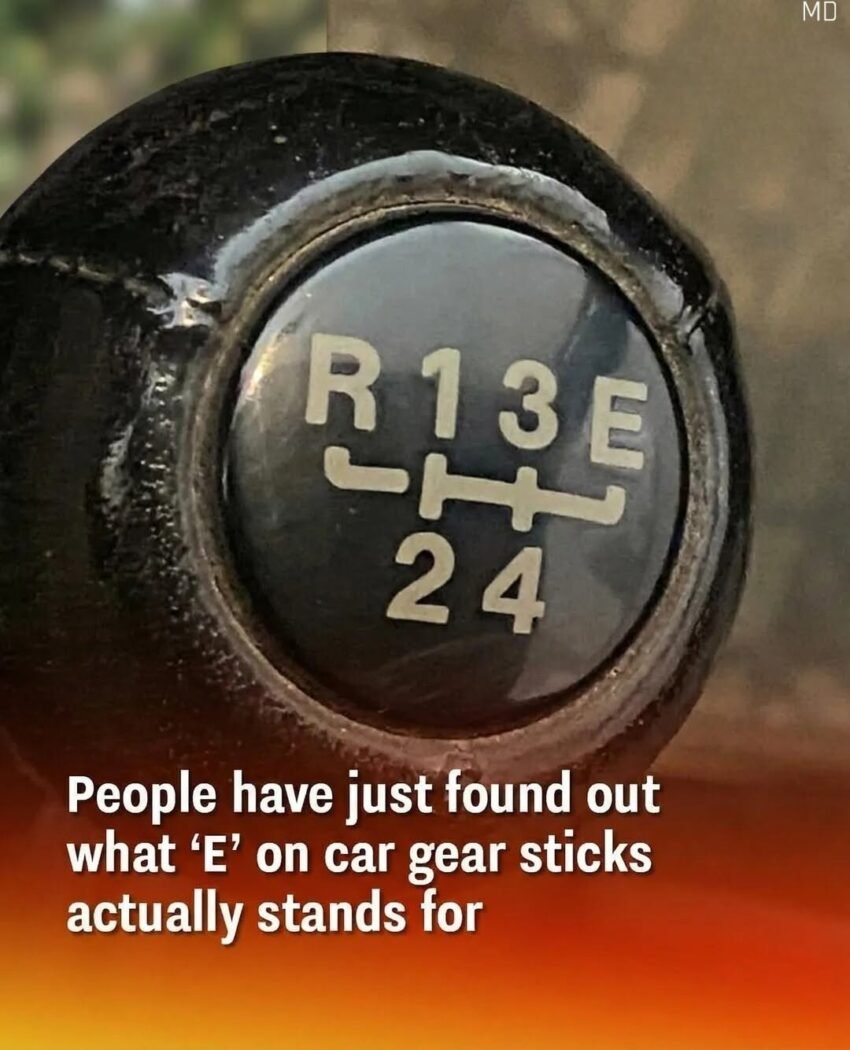
On old car gear shifts, the letter “E” can mean different things depending on the car model and transmission type. It is not a universal gear symbol, but these are the most common meanings:
1. E = Economy mode (most common on older automatic cars)
In many older automatic transmissions, “E” means Economy.
- The transmission shifts into higher gears earlier to save fuel.
- Engine RPM stays lower during normal driving.
- The car feels smoother but may accelerate more slowly.
- It is designed for normal cruising, especially on highways.
Example:
- D = normal Drive mode (more responsive shifting)
- E = Economy mode (fuel-saving shifting)
2. E = Emergency gear / Extra gear (less common)
Some older vehicles used E to indicate an extra driving range or a special transmission setting, depending on the manufacturer.
3. E = Electronic mode
In some automatic transmissions, E may refer to an electronic control mode, where the transmission computer manages shifting instead of a purely mechanical system.
4. E on manual gear patterns
If you see an “E” near a manual gear lever, it may sometimes be a marking added by the manufacturer for a special function, such as:
- E = Economy gear
- E = Extra-low gear
- A special overdrive or auxiliary gear position
How to identify the exact meaning
The meaning depends on:
- Car make and model
- Year of manufacture
- Whether it is automatic, manual, or semi-automatic
- Where the “E” appears (gear selector, dashboard, or shift knob)
If you tell me the car model, year, and where the “E” is written (for example: “P R N D E” on the automatic shifter), I can explain the exact function.