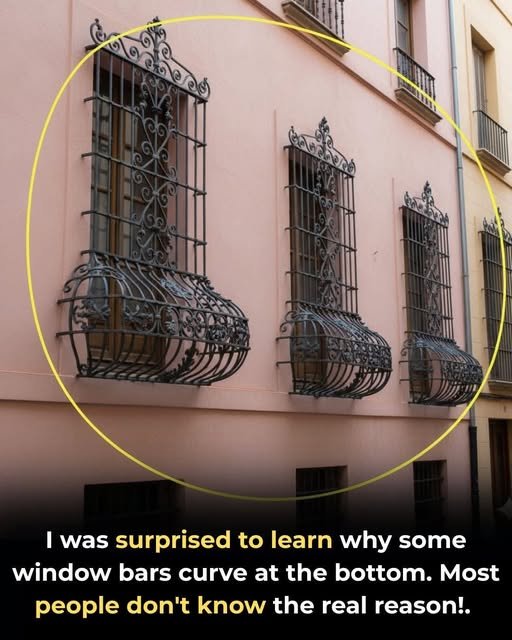
Some window bars are curved at the bottom because the shape serves several practical, architectural, and safety purposes. The curved section is not just for decoration; it often has a specific function.
1. Security and strength
Traditional window bars (also called security grilles or iron bars) were designed to prevent people from forcing their way through windows. A curved bottom can:
- Make it harder to get a good grip with tools or hands.
- Add strength by avoiding sharp corners where the metal could be bent more easily.
- Help distribute force better than a simple flat extension.
2. Allowing ventilation and window operation
Many older buildings used curved bars at the lower part of windows because:
- The curve creates extra space near the window opening.
- It allows windows to open outward or inward without the bars blocking movement.
- It provides room for people to place flower boxes or other items outside the window.
3. Architectural style and decoration
In many places, especially older homes and historic buildings, curved bars are part of the design:
- Wrought iron workers often created scrolls, bends, and curves as decorative features.
- Curved shapes matched architectural styles such as Victorian, Mediterranean, colonial, and traditional urban buildings.
- They made security features look more elegant.
4. Safety during emergencies
Some window bars have a curved or outward shape because:
- They can provide more space for escape routes.
- Certain modern security bars are designed with quick-release mechanisms, and the shape can help avoid blocking exits.
5. Protection for plants and people
A common style is a “belly” or “bowed” window guard, where the lower part curves outward. This can:
- Create space for window boxes with flowers.
- Prevent people from accidentally pressing directly against the glass.
- Add a protective barrier while keeping the window useful.
6. Historical reason
Before modern steel manufacturing, many window bars were hand-forged from iron. Craftsmen naturally used curves because:
- Curved iron could be shaped without weakening it as much as sharp bends.
- Decorative ironwork was a sign of craftsmanship and status.
So, a curved bottom on window bars is usually a combination of security, strength, usefulness, and appearance. The exact reason depends on the building’s age, location, and design.