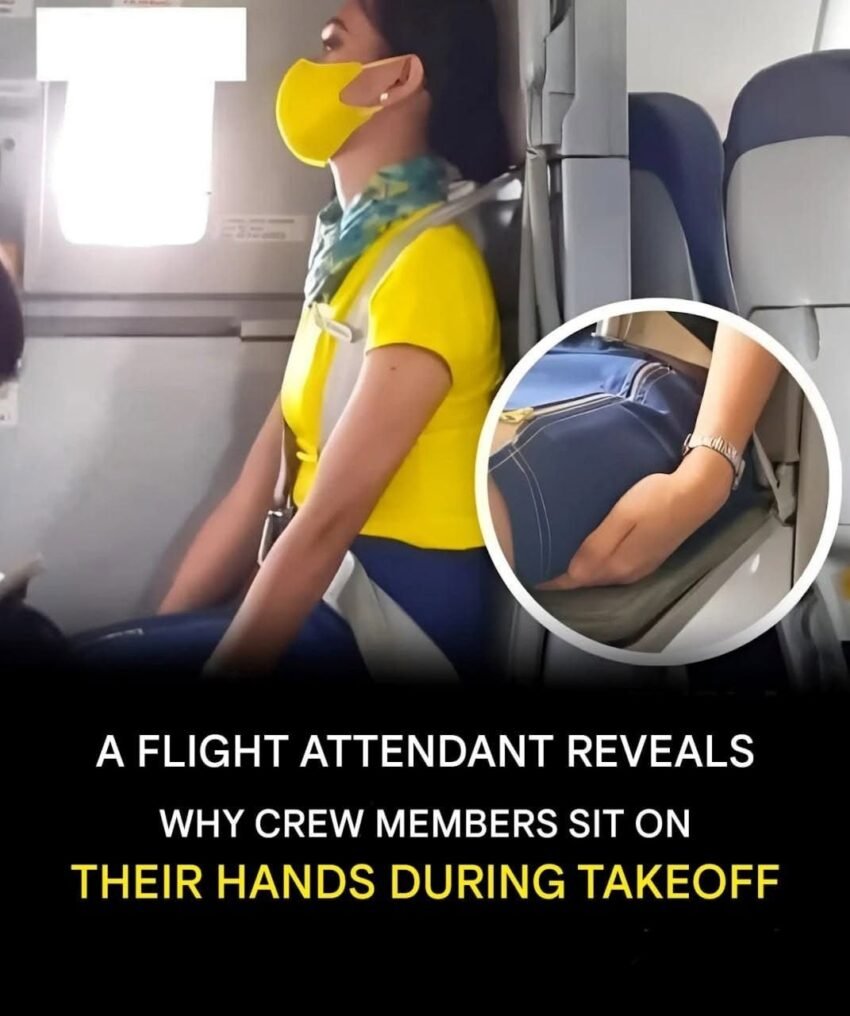
Flight attendants often place their hands under their thighs (or sit on their hands) during takeoff and landing because it is part of a safety procedure called the “brace position” preparation. It is not for comfort or because they are resting their hands—it has specific safety reasons.
1. To protect their hands and arms during an emergency
Takeoff and landing are the phases of flight when accidents are statistically more likely to occur. If an aircraft experiences a sudden stop, hard landing, or impact, the body can be thrown forward or sideways.
Keeping hands under the thighs helps:
- Prevent arms from being flung forward and injured.
- Keep hands away from loose objects or surfaces that could cause injury.
- Reduce the chance of broken fingers, wrist injuries, or arm damage.
2. To keep the body in a stable position
The position helps flight attendants maintain a controlled posture:
- Feet are usually flat on the floor.
- Hands are secured under the thighs.
- The body remains upright and ready.
This reduces unnecessary movement during a sudden impact and helps them absorb forces more safely.
3. To avoid instinctive reactions
In a sudden emergency, humans naturally try to:
- Grab something,
- Reach out with their hands,
- Protect their face.
Those reactions can actually cause more injuries. Keeping hands secured prevents instinctive movements and keeps the body in a safer posture.
4. To stay alert and focused
Flight attendants are not “relaxing” during this time. While seated with hands positioned this way, they are usually:
- Listening for unusual sounds or changes in the aircraft.
- Monitoring the cabin.
- Checking emergency conditions mentally.
- Preparing to act immediately if needed.
5. It is part of their trained safety routine
Before takeoff and landing, cabin crew perform a silent review (sometimes called a “30-second review” or similar depending on the airline). They mentally check:
- Emergency exits and equipment locations.
- Evacuation commands.
- Possible hazards.
- Their responsibilities during an emergency.
The hand position is one part of this routine.
Why mainly during takeoff and landing?
Because these are the times when:
- The aircraft is closest to the ground.
- There is less time to recover from a problem.
- The aircraft configuration changes rapidly (flaps, landing gear, speed changes).
- Most serious aviation accidents historically occur during these phases.
So, the reason flight attendants keep their hands under their thighs is to reduce injury risk, maintain a protective posture, and stay ready to respond quickly during the most critical parts of a flight.