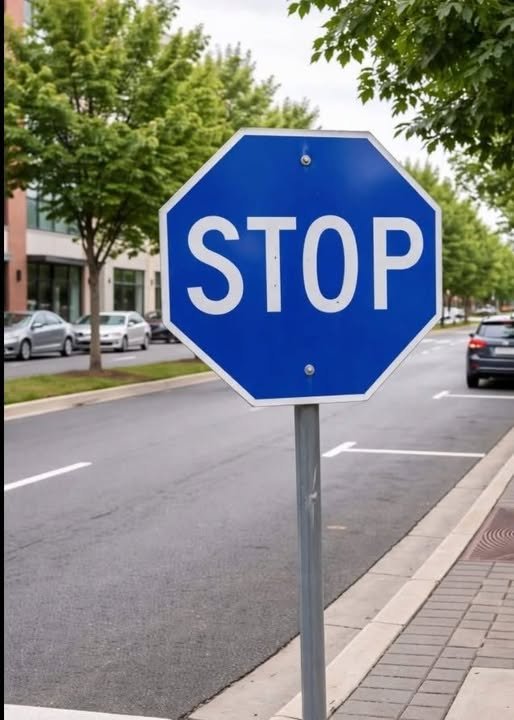
Blue stop signs are unusual, but they do exist. They often surprise drivers because the familiar red octagonal STOP sign is the standard on public roads throughout the United States and many other countries. Here’s a detailed explanation of why some stop signs are blue and what drivers should do when they encounter one.
Why Are Some Stop Signs Blue?
Blue stop signs are not official public traffic-control signs approved for use on public roads by U.S. transportation authorities. Instead, they are generally installed on private property.
Common places where blue stop signs appear include:
- Private neighborhoods
- Gated communities
- Shopping centers
- Hotels and resorts
- University campuses
- Business parks
- Industrial facilities
- Golf courses
- Private roads and ranches
Property owners use them to regulate traffic where government-issued road signs do not apply.
Why Aren’t They Red?
Public-road stop signs follow strict federal standards under the Manual on Uniform Traffic Control Devices (MUTCD), which specifies:
- Red background
- White lettering
- Octagonal shape
Private property owners sometimes choose blue signs because they:
- Differentiate private traffic control from official road signs.
- Match community or company branding.
- Avoid confusion with government-issued signs while still conveying the message to stop.
Are Blue Stop Signs Legally Enforceable?
The answer depends on where they are located.
On private property
Many blue stop signs function as traffic-control devices established by the property owner.
Ignoring them could result in:
- Property rules violations
- Liability if an accident occurs
- Traffic enforcement in some jurisdictions where local laws permit police to enforce traffic regulations on private roads.
On public roads
A blue stop sign would generally not meet federal standards for official traffic control and normally would not be used.
What Should Drivers Do?
Regardless of color, the safest action is:
- Come to a complete stop.
- Check for pedestrians.
- Yield to cross traffic.
- Proceed only when it is safe.
Even if the sign is unofficial, stopping helps prevent collisions and protects pedestrians.
Why Is Red the Standard Color?
Stop signs were not always red.
Historically:
- Early stop signs were white with black letters.
- In the 1920s, many stop signs became yellow because yellow was easier to see than the red paints available at the time.
- By 1954, improved paint technology allowed durable, highly visible red signs, which then became the national standard.
Are Blue Stop Signs Common in Hawaii?
Yes. Hawaii has become known for having more blue stop signs than most U.S. states because many are installed on privately owned roads and properties. Visitors are often surprised to encounter them there.
Other Unusual Stop Signs
Besides blue stop signs, drivers may also encounter:
- Perforated stop signs with holes that reduce wind resistance in windy areas.
- LED-illuminated stop signs that improve visibility.
- Larger or high-visibility stop signs at dangerous intersections.
Key Takeaways
- Blue stop signs are primarily found on private property.
- They are not the standard official stop signs used on public roads.
- Their purpose is still to tell drivers to stop completely.
- Drivers should treat a blue stop sign with the same caution as a red one to ensure safety and comply with applicable property rules or local laws.
- The familiar red stop sign became the U.S. standard in 1954 after decades of evolution in traffic-sign design.