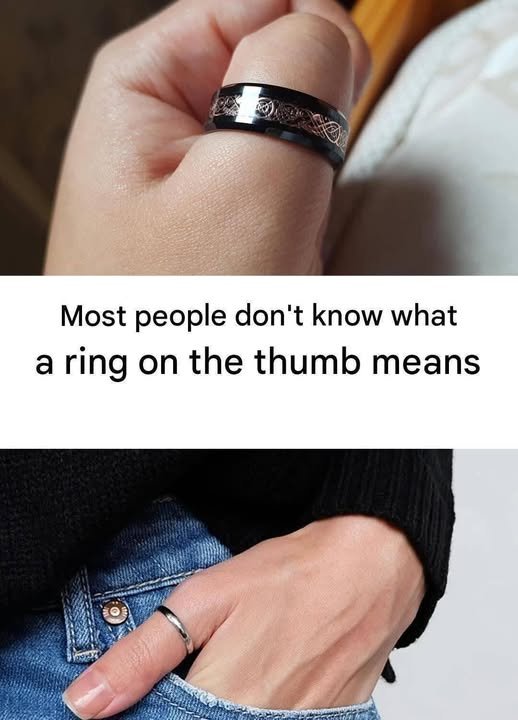
Here’s a clear breakdown:
1) Fashion & Personal Style (most common today)
In modern use, a thumb ring usually means:
- Confidence and individuality
- A bold or non-traditional fashion choice
- Independence from “normal” jewelry rules
Because the thumb is separate from the other fingers, wearing a ring there stands out more.
2) Historical meanings
In ancient times, especially in Rome, Greece, and parts of Asia, thumb rings sometimes meant:
- Wealth or high social status (since rings were expensive)
- Strength and authority (thumb = strong finger)
- Archery skill in some cultures (thumb protection rings were used in bow shooting in Asia)
3) Psychological symbolism (modern interpretations)
Some people associate thumb rings with personality traits like:
- Strong willpower
- Self-confidence
- Desire for control or independence
- Nonconformity (not following social rules)
These are interpretations—not proven facts, but they are common beliefs.
4) Cultural or subcultural meanings (varies widely)
In some modern subcultures, people try to assign meanings, but they are not universal. For example:
- In some Western fashion trends, it can signal boldness or luxury
- In some groups, it’s mistakenly linked with sexuality or relationship status—but this is not reliable or consistent
Important: you cannot assume someone’s identity or personality just from a thumb ring.
5) Practical historical use (important fact)
In parts of Asia (like China and Mongolia), thumb rings were originally used for:
- Archery protection (to pull bowstrings safely)
- Sometimes made of bone, jade, or metal
Simple conclusion
A thumb ring today usually means:
“This person likes unique style and self-expression.”
It does not have one universal hidden meaning.
If you want, I can also tell you what thumb rings mean in Islamic culture, Western dating interpretations, or gender symbolism—they differ a lot and people often get confused about them.