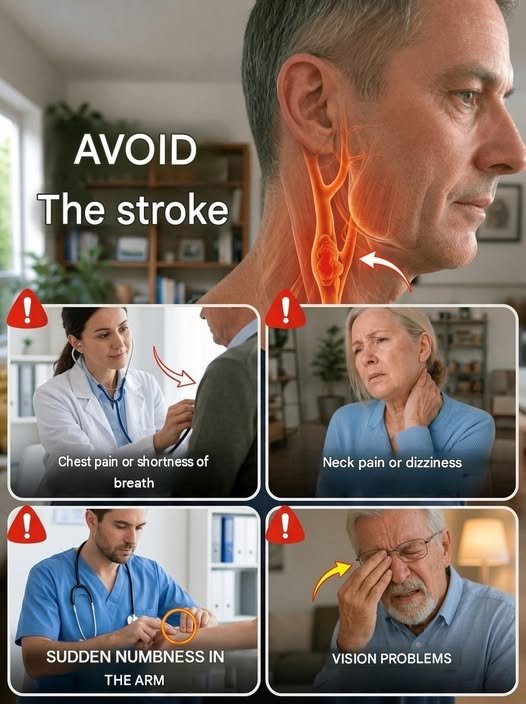
If you mean “9 warning signs of blocked or narrowed carotid arteries, explained in detail,” the most important point is that carotid artery disease is often silent. Many people have no symptoms until a transient ischemic attack (TIA) or stroke occurs. The warning signs below are therefore mainly signs that reduced blood flow or plaque-related clots may be affecting the brain.
9 warning signs of carotid artery blockage or narrowing
1. Sudden weakness or numbness on one side
A sudden feeling of weakness, heaviness, tingling, or numbness involving the face, arm, or leg—especially on one side—is one of the most important warning signs.
For example, you might suddenly:
- Drop something from one hand.
- Have difficulty lifting one arm.
- Feel that one leg is unusually weak.
- Notice numbness around one side of your mouth or face.
This can happen when part of the brain is temporarily or permanently deprived of blood and oxygen. It may represent a TIA or stroke, rather than simply a problem with the carotid artery itself.
Do not wait to see whether it improves.
2. Sudden facial drooping
One side of the face may suddenly become weak or numb. A person may notice that:
- One side of the mouth droops.
- Their smile becomes uneven.
- One cheek feels numb.
- They have difficulty controlling one side of the face.
A quick way to recognize this is to ask the person to smile and look for asymmetry.
Facial drooping is part of the American Stroke Association’s B.E. F.A.S.T. stroke warning system.
3. Sudden trouble speaking or understanding speech
Another major warning sign is a sudden change in language ability.
You might:
- Slur your words.
- Have difficulty getting words out.
- Say words that don’t make sense.
- Suddenly have trouble understanding what someone is saying.
- Be unable to name familiar objects.
- Suddenly have difficulty reading or writing.
These symptoms can occur when the areas of the brain responsible for speech and language are affected by inadequate blood flow.
Importantly, speech problems that disappear after several minutes are not necessarily harmless. They can be a TIA, which requires urgent medical evaluation.
4. Sudden loss or change of vision
Carotid disease can be associated with sudden visual symptoms, particularly temporary loss of vision in one eye.
A person may describe it as:
- A curtain or shade coming down over one eye.
- Sudden blindness in one eye.
- Blurred vision.
- Double vision.
- A sudden loss of part of the visual field.
Temporary vision loss can occur when an embolus or clot travels toward the eye or brain. It can be a warning sign of a TIA.
Sudden vision loss should be treated as an emergency, even if vision returns to normal.
5. Sudden dizziness, loss of balance, or difficulty walking
A sudden episode of:
- Severe dizziness,
- Loss of coordination,
- Trouble walking,
- Unsteadiness,
- Loss of balance,
can be a neurological warning sign.
Dizziness by itself is very common and has many possible causes, so it does not automatically mean a carotid artery is blocked. However, sudden dizziness accompanied by weakness, vision changes, speech difficulty, or severe imbalance is much more concerning for a stroke or TIA.
6. Sudden, severe headache with no obvious cause
A sudden, unusually severe headache—particularly one that is unlike your usual headaches—can be associated with a serious neurological event.
A severe headache is included among recognized stroke/TIA warning symptoms, although it is not specific to carotid artery disease. Other causes of sudden severe headache can also be dangerous.
If the headache occurs together with weakness, confusion, speech difficulty, vision changes, dizziness, or facial drooping, seek emergency medical attention immediately.
7. Repeated “mini-stroke” episodes that completely disappear
This is particularly important.
A person might experience:
- Weakness for 5–10 minutes.
- Temporary difficulty speaking.
- Brief loss of vision.
- Sudden numbness that disappears.
- Temporary difficulty walking.
Then everything seems completely normal again.
This can be a transient ischemic attack (TIA). A TIA occurs when blood flow to part of the brain is temporarily interrupted. Symptoms can resolve because the blockage clears or blood flow is restored—but that does not mean the underlying problem is gone.
The American Stroke Association describes TIA as a “warning stroke” because it can signal a future stroke. You cannot reliably determine at home whether an episode was a TIA or an actual stroke.
8. Multiple different neurological symptoms occurring suddenly
Sometimes the warning isn’t one isolated symptom. A person can suddenly develop a combination such as:
Face drooping + arm weakness + speech difficulty
or:
Vision loss + dizziness + difficulty walking
or:
Numbness + confusion + speech problems
A sudden combination of neurological symptoms is particularly concerning because different regions of the brain may be affected.
The American Stroke Association summarizes the major warning pattern as B.E. F.A.S.T.:
- B — Balance: sudden loss of balance or coordination
- E — Eyes: sudden vision changes
- F — Face: facial drooping
- A — Arm: sudden weakness or numbness
- S — Speech: difficulty speaking or understanding
- T — Time: call 911 immediately
9. Having carotid artery disease without symptoms is itself a warning
This may sound contradictory, but it is extremely important: you can have significant carotid artery narrowing without feeling anything at all.
Carotid artery disease commonly develops gradually. Early disease often produces no recognizable symptoms, and the first obvious manifestation may be a TIA or stroke.
Therefore, waiting for “symptoms of a blocked carotid artery” is not a reliable strategy.
People with risk factors such as:
- High blood pressure
- Smoking or tobacco use
- Diabetes
- High cholesterol
- Obesity
- Physical inactivity
- Older age
- Family history of atherosclerosis
- Sleep apnea
may need to discuss cardiovascular and stroke risk with their healthcare professional.
🚨 When to call 911
Call 911 immediately if you or someone else suddenly develops facial drooping, arm or leg weakness/numbness, speech difficulty, confusion, sudden vision loss, severe balance problems, or another possible stroke symptom.
Do not wait for symptoms to disappear. A TIA can look exactly like a stroke initially, and only medical assessment can determine what happened.
If symptoms have already disappeared, still seek emergency medical evaluation. The American Stroke Association recommends urgent assessment because a TIA can precede a more serious stroke.
How carotid blockage is diagnosed
A healthcare professional may begin with a neurological and physical examination, including listening over the carotid arteries for a bruit (an abnormal whooshing sound). Depending on the situation, testing can include carotid ultrasound, CT/MRI, CT angiography, or MR angiography.
One important misconception
There usually aren’t reliable symptoms such as neck pain, neck swelling, or a particular type of headache that tells you “your carotid artery is 70% blocked.” The degree of narrowing cannot be determined from symptoms alone. Imaging is needed to evaluate the arteries.
And because carotid disease can be silent, the safest approach is to focus on stroke/TIA warning signs and cardiovascular risk factors, rather than trying to diagnose blockage based on how your neck feels.
If you’re asking because you or someone near you is currently experiencing one of these symptoms, tell me which symptom is happening and when it started—but call 911 now rather than waiting for my response if it is sudden or ongoing