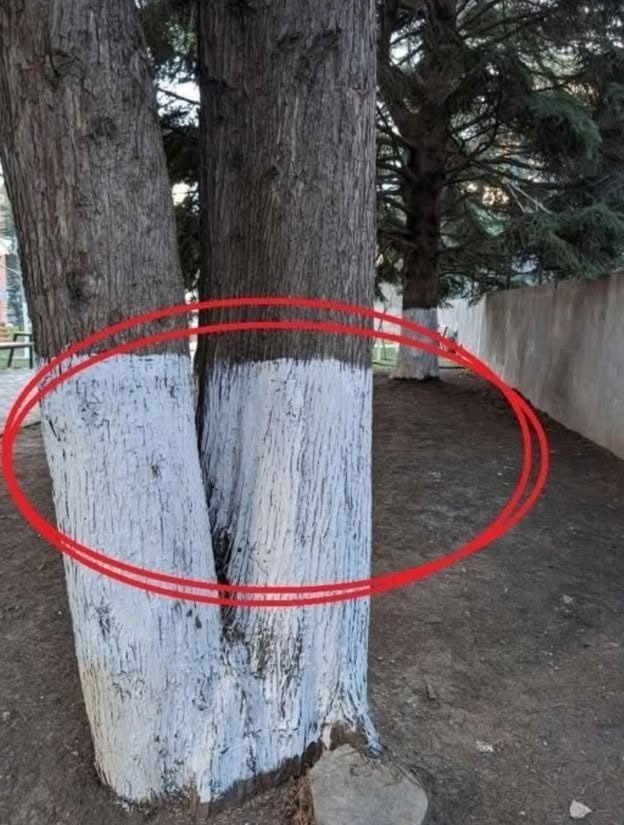
Why Are Some Trees Painted White? A Winter Secret, Revealed


Have you ever walked through a garden, park, orchard, or countryside in winter and noticed that the lower parts of some tree trunks are painted white?
At first glance, it might seem like decoration, an unusual gardening tradition, or simply a way to make trees look neat. But there is a fascinating scientific reason behind this practice.
Painting tree trunks white is primarily a protective measure. It helps trees survive harsh winter conditions, particularly sudden temperature changes, intense sunlight, and damage to their bark.
This traditional technique is commonly called tree whitewashing or trunk whitewashing.
Let’s explore the science, history, benefits, and practical reasons behind this winter secret.
1. The biggest reason: Protecting trees from winter sunscald


One of the main reasons trees are painted white is to prevent a condition called sunscald.
You might wonder: How can sunlight damage a tree during winter when temperatures are freezing?
The answer lies in the unusual way tree trunks respond to sunlight.
How does winter sunscald happen?
During winter, especially on sunny days:
-
Sunlight falls directly on the tree trunk.
-
The dark-colored bark absorbs solar radiation and becomes warmer.
-
Cells beneath the bark may become active as temperatures rise.
-
When the sun disappears or temperatures drop at night, the trunk cools rapidly.
-
The sudden temperature change can damage living tissues beneath the bark.
This damage can cause sections of bark to crack, split, or die.
The problem is especially common on the south-facing or southwest-facing side of tree trunks in the Northern Hemisphere.
How does white paint help?
White surfaces reflect much more sunlight than dark surfaces.
When a tree trunk is coated with suitable whitewash:
-
It reflects a significant portion of incoming sunlight.
-
The bark absorbs less solar heat.
-
The trunk experiences less extreme temperature fluctuation.
-
The risk of winter sunscald and associated bark injury is reduced.
In simple words, white paint acts like a reflective shield against winter sunlight.
2. Preventing bark from cracking and splitting


Tree bark is more than an outer covering. It protects important living tissues responsible for transporting water and nutrients and supporting growth.
Underneath the outer bark are two particularly important tissues:
-
Phloem: Transports sugars produced by the leaves to other parts of the tree.
-
Cambium: A thin layer of actively dividing cells that produces new wood and inner bark.
When extreme temperature fluctuations injure these tissues, the bark can crack, peel, or separate from the wood.
This is sometimes called southwest injury because it frequently affects the southwest-facing side of a trunk in the Northern Hemisphere.
Whitewashing helps reduce the amount of solar heat absorbed by the bark, lowering the risk of this injury.
Why does this matter?
Severe bark damage can:
-
Interrupt the movement of nutrients.
-
Create wounds that take years to heal.
-
Weaken young trees.
-
Allow disease-causing organisms to enter.
-
Provide entry points for wood-boring insects.
According to the University of California’s agricultural experts, sunburned tree trunks are particularly vulnerable to wood-boring pests.
3. Protecting young trees with thin bark

Not all trees need white paint. Young trees are generally more vulnerable because their bark is thinner and less developed.
Some trees that can benefit from trunk protection include:
-
Apple trees
-
Peach trees
-
Cherry trees
-
Maple trees
-
Honey locust trees
-
Linden trees
-
Ash trees
-
Beech trees
Newly planted trees can be especially vulnerable because their trunks may suddenly be exposed to sunlight after growing in a shaded nursery or under protective vegetation.
As a tree matures, its bark usually becomes thicker and better able to withstand temperature fluctuations.
Therefore, whitewashing is particularly useful for young fruit trees and thin-barked ornamental trees.
4. Reducing summer sunburn, too

Although whitewashing is often associated with winter, it can also protect trees during summer.
Think about a tree growing in a hot, sunny orchard. Its trunk may receive intense sunlight throughout the day.
Dark bark absorbs solar energy, and excessive heating can damage the living tissues underneath it.
This is known as sunburn injury.
It is particularly common when:
-
A tree has been heavily pruned.
-
Previously shaded bark suddenly becomes exposed.
-
Young trees have insufficient foliage to shade their trunks.
-
Trees grow in areas with intense sunlight.
-
Surrounding vegetation or structures are removed.
White coatings reflect sunlight and help prevent excessive heating.
So, whitewashing is not exclusively a winter technique. It can also be a useful summer protection measure in hot climates.
5. Does white paint protect trees from insects and diseases?

This is an interesting part of the story.
White paint is not a universal insect repellent, nor does it kill insects living inside a tree.
However, it can indirectly reduce certain pest and disease problems.
Here is how:
-
Sunburn damages the bark.
-
Damaged bark may crack, peel, or expose underlying tissues.
-
These wounds can attract certain wood-boring insects.
-
Insects and disease-causing organisms can exploit damaged areas.
-
Further injury can weaken the tree.
By reducing sunburn, whitewashing can help prevent some of the wounds that make trees more susceptible to these problems.
It is therefore a preventive measure, not an insecticide or fungicide.
6. Why is white the preferred colour?

The answer is physics!
Different colours absorb and reflect different amounts of sunlight.
-
Black absorbs a large proportion of incoming visible light and can become hot.
-
Dark brown also absorbs considerable solar energy.
-
White reflects much more incoming visible light.
-
Light colours generally absorb less solar energy than dark colours.
This is why white is particularly useful for protecting tree trunks.
Imagine two identical young apple trees standing next to each other in winter.

Unpainted trunk
Absorbs more sunlight and can experience greater daytime heating.

Whitewashed trunk
Reflects more sunlight and helps keep bark temperatures more stable.
The whitewashed tree is less likely to experience the extreme daytime warming that contributes to winter sunscald.
7. What exactly is used to paint tree trunks?
Not every kind of white paint is suitable for trees.
Tree whitewashing traditionally uses lime-based mixtures or specially formulated tree-protection products. Some modern horticultural recommendations use diluted water-based latex paint.
Common options include:
|
Material |
Purpose |
|---|---|
|
Lime-based whitewash |
Traditional reflective trunk coating |
|
Suitable white water-based latex paint |
Reflects sunlight and reduces bark heating |
|
Commercial tree whitewash |
Formulated specifically for tree protection |
|
White horticultural tree wrap |
Physically shields bark from direct sunlight |
An important safety point: Ordinary household exterior paint, oil-based paint, and unsuitable coatings should not be used indiscriminately on living trees. Some formulations contain additives that can injure plant tissues.
The University of California Integrated Pest Management Program recommends white interior latex paint diluted with an equal amount of water for susceptible trunks. Always follow local horticultural guidance and the product label.
8. How do farmers and gardeners whitewash trees?


The process is relatively simple, although the correct material and timing are important.
Step-by-step process
-
Inspect the tree: Look for damaged bark, cracks, and existing pest problems.
-
Clean the trunk gently: Remove loose dirt and debris. Do not scrape healthy bark.
-
Choose an appropriate coating: Use a tree-safe commercial whitewash or a suitable water-based horticultural paint.
-
Prepare the mixture: If using the recommended interior white latex paint, mix equal parts paint and water.
-
Apply carefully: Brush a thin, even coating onto the exposed lower trunk.
-
Cover vulnerable areas: Pay particular attention to the south- and southwest-facing surfaces in the Northern Hemisphere.
-
Check periodically: Inspect the coating and reapply according to the product instructions if necessary.
Avoid painting damaged or diseased areas without first identifying the cause of the injury.
Important: Hydrated lime is caustic and can cause skin and eye injuries. Do not experiment with concentrated lime mixtures without an established horticultural recipe and suitable protective equipment.
9. When should trees be painted white?
The best timing depends on the climate and the reason for protection.
|
Season |
Why whitewash may be useful |
|---|---|
|
Autumn |
Prepare young trees for winter sunlight and freezing temperatures |
|
Winter |
Reduce daytime bark heating and nighttime temperature fluctuations |
|
Early spring |
Continue protection while freezing nights and strong sunlight remain possible |
|
Summer |
Protect exposed trunks against intense solar radiation |
For winter sunscald prevention, protection should ideally be applied before the cold season begins.
In colder climates, commercial tree wraps are another option. They should generally be removed in spring according to the manufacturer’s instructions because leaving unsuitable wraps in place can create other problems.
10. Is whitewashing necessary for every tree?
No. This is an important distinction.
Whitewashing is generally most useful for:
-
Newly planted trees.
-
Young fruit trees.
-
Trees with naturally thin bark.
-
Trees whose trunks have recently become exposed to direct sunlight.
-
Trees growing in places with significant winter temperature fluctuations.
It is usually less necessary for mature trees with thick, protective bark and naturally shaded trunks.
For example, a mature oak with thick bark may not need the same protection as a young apple tree.
The best approach is to consider the tree species, age, local climate, and amount of sunlight reaching its trunk.
11. Does whitewashing actually prevent frost?
Not completely!
This is a common misunderstanding.
Whitewashing does not make a tree immune to frost, freezing temperatures, or winter storms.
Instead, it reduces excessive heating of the bark during sunny winter days. This helps limit sudden temperature changes that can contribute to sunscald.
It does not:
-
Prevent the entire tree from freezing.
-
Protect roots against every type of frost.
-
Stop all insect infestations.
-
Cure existing bark diseases.
-
Prevent every type of winter injury.
Think of whitewashing as a protective measure rather than a complete winter-proofing solution.
12. The historical tradition of whitewashing trees

Whitewashing tree trunks is not a completely modern agricultural invention.
Farmers and orchard growers have used lime-based coatings and other protective trunk treatments for generations.
Traditional lime whitewash was also used in agricultural buildings, walls, and other structures because it provided a relatively inexpensive white protective coating.
In orchards, white trunk coatings became a practical way to reduce sunlight-related damage to vulnerable trees.
Today, horticultural research has helped explain the scientific mechanism behind this traditional practice: reflecting sunlight reduces bark heating and helps prevent sun injury.
The practice continues in fruit-growing regions around the world, particularly where sunny winter days are followed by freezing nights.
13. Interesting scientific facts about whitewashed trees
Here are some fascinating facts that make this practice even more interesting:

1. Whitewashing is especially useful for young trees.
Their bark is thinner and more vulnerable to temperature-related injury.

2. Damage often occurs on the southwest side.
This is because of the direction and intensity of sunlight during winter afternoons in the Northern Hemisphere.
3. The paint is not meant to decorate the tree.
Its primary purpose is to reflect solar radiation and reduce bark heating.

4. The most important protection happens beneath the bark.
Whitewashing helps protect living tissues that support the tree’s growth and transport systems.

5. Whitewashing can be useful in summer as well.
It can reduce sunburn on exposed trunks in hot, sunny climates.
14. What happens if trees are not protected?
Consider a young fruit tree growing in an area with sunny winter afternoons and freezing nights.
Without suitable protection, the following sequence may occur:
The winter damage cycle
-
Bright winter sunshine
The dark trunk absorbs sunlight and warms up.
-
Tissue becomes warmer
Living cells beneath the bark become more active.
-
Sudden nighttime freezing
The temperature drops rapidly, damaging vulnerable tissues.
-
Bark injury develops
Cracks, peeling, and dead patches may appear.
-
Secondary problems arise
Wounded areas can become vulnerable to wood-boring insects and disease.
Prevention is better than repair
Whitewashing helps interrupt this cycle by reducing daytime bark heating.
15. Frequently asked questions
Q1. Why are only the lower parts of trees painted white?
The lower trunk is often exposed to direct sunlight and is particularly vulnerable to temperature fluctuations. It is also the part that is easiest to protect with paint or tree wrap.
Q2. Does white paint harm trees?
Appropriate horticultural whitewash or correctly selected and diluted water-based paint can be safe. However, unsuitable paints and chemical coatings can damage living bark.
Q3. Can I paint my apple tree white?
Yes. Young apple trees are among the trees that may benefit from whitewashing, particularly in regions with sunny winters and freezing nights.
Q4. Does whitewashing help trees grow faster?
Not directly. It does not act as a fertilizer or growth stimulant. Its benefit is indirect: protecting the bark can help prevent injuries that interfere with healthy development.
Q5. Why are trees painted white in countries with hot climates?
In hot climates, whitewashing can protect exposed trunks and major branches from excessive solar heating and sunburn.
Q6. Does whitewashing kill bacteria and fungi?
Not necessarily. Ordinary white trunk paint is not a reliable disinfectant or disease treatment. Its main purpose is physical protection from sunlight.
Q7. Can I use white plastic instead of paint?
Yes. Specially designed white horticultural wraps and tree guards can provide protection. They must be installed correctly and removed or adjusted according to their instructions.
Final takeaway: The winter secret revealed

The next time you see a tree with a white-painted trunk, remember that there is more to it than appearance.
That simple white coating is an example of practical agricultural science.
It reflects sunlight, helps regulate bark temperature, reduces the risk of winter sunscald, and protects vulnerable trees from injuries that can lead to further problems.
Nature has its own protective mechanisms, but sometimes a little help from humans makes a big difference.
A simple coat of white can help a young tree survive the challenges of winter and continue growing for many years.
Further reading and scientific references
For readers interested in the horticultural science behind this practice:
-
University of California – Whitewashing Trunks : Practical instructions and recommendations for protecting tree trunks.
-
Utah State University Extension – Sunscald : Explanation of winter sunscald and its effects on trees.
-
UC Integrated Pest Management – Sunscald : Symptoms, causes, and prevention.
-
Colorado State University – Sunscald of Trees : Tree protection methods and winter care.
-
Missouri Botanical Garden – Sunscald of Woody Plants : Susceptible tree species and management strategies.