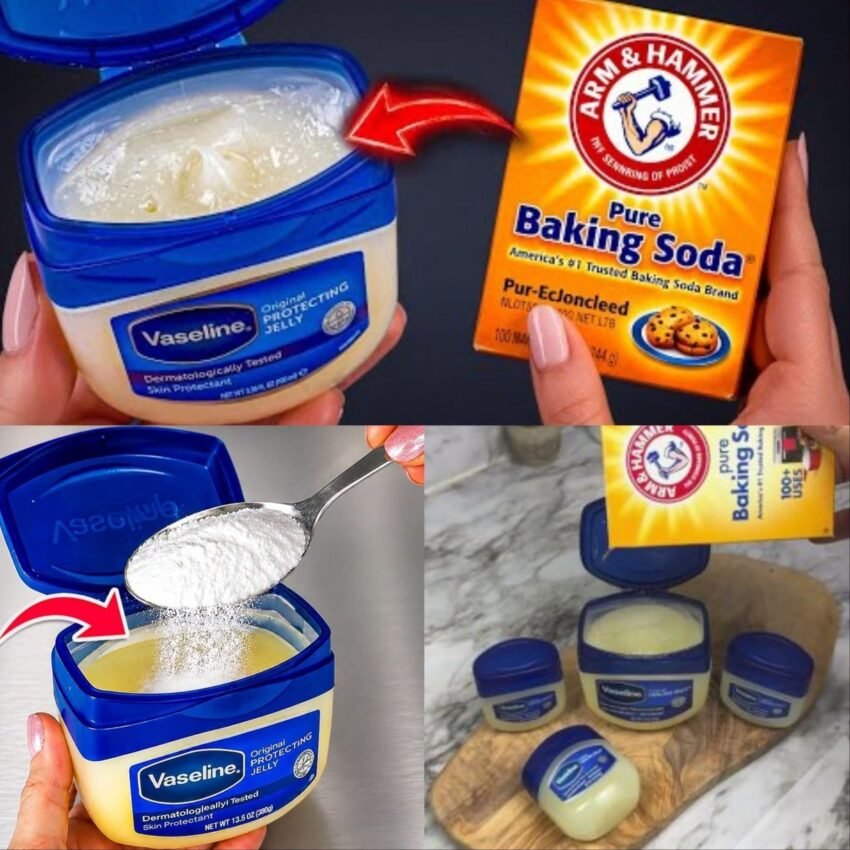
If you mean the viral “mix baking soda with Vaseline” skincare recipe, there is an important safety point: I would not recommend putting a baking-soda/Vaseline mixture on the face or sensitive skin. Petroleum jelly itself is well supported for moisturizing and protecting dry skin, but baking soda can be irritating, especially on facial or already-sensitive skin. The American Academy of Dermatology recommends plain petroleum jelly for dry skin and several protective skincare uses.
What the two ingredients actually do
Vaseline/petroleum jelly
- Forms an occlusive layer that helps reduce water loss from the skin.
- Can soften dry, cracked skin.
- Can protect minor cuts and scrapes when used appropriately.
- Can help with chafing.
- Can moisturize dry nails and cuticles.
Baking soda
- Is alkaline and has mild abrasive properties.
- It is sometimes promoted online as a homemade exfoliant or deodorizing ingredient.
- However, that does not mean it is appropriate for routine facial skincare. Its alkalinity and abrasive nature can disturb or irritate the skin, particularly with repeated use.
Why the combination is often misunderstood
You may see claims that this mixture can remove dark spots, whiten skin, eliminate wrinkles, treat acne, remove unwanted hair, or “detox” the skin. These claims should not be treated as established medical facts.
Vaseline does not bleach pigmentation, and adding baking soda doesn’t turn it into a proven treatment for dark spots or wrinkles. For those concerns, evidence-based skincare ingredients and, when necessary, a dermatologist are safer choices.
If your goal is simply softer, smoother skin
A much safer homemade approach is plain petroleum jelly:
- Wash the area gently.
- Pat it mostly dry, leaving the skin slightly damp.
- Apply a thin layer of plain petroleum jelly.
- Use it especially on very dry areas such as hands, heels, elbows, lips, or cuticles.
- Stop if you develop burning, redness, itching, or a rash.
Dermatologists specifically recommend applying petroleum jelly to damp skin to help lock in moisture.
What about using it on the face?
Be more cautious. The AAD notes that people who are acne-prone may experience breakouts with petroleum jelly on the face, so it isn’t necessarily appropriate for everyone.
And I would not recommend a baking-soda/Vaseline mask around the eyes, on the lips, on broken skin, or on the genitals.
If you tell me what you want the mixture for—dark spots, wrinkles, dry skin, rough feet, underarms, acne, or unwanted hair—I can explain whether the viral recipe actually works and give you a safer alternative.