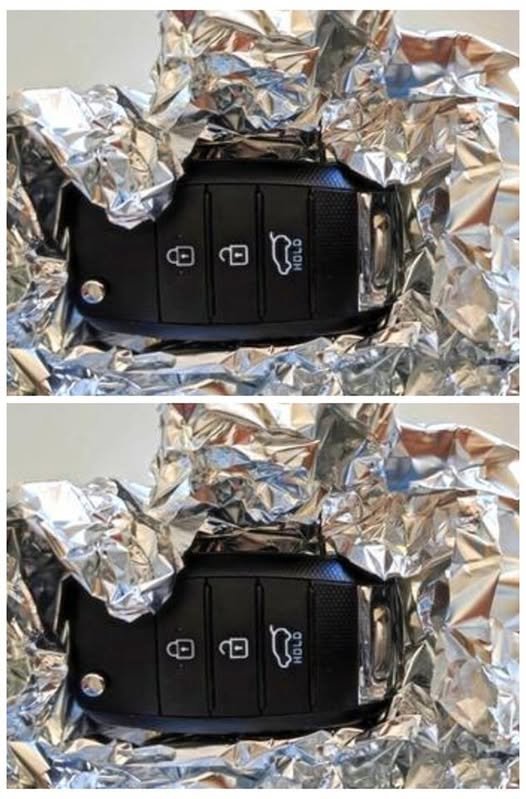
The advice from a former police officer about wrapping car keys in aluminum foil usually refers to protecting keyless entry (key fob) vehicles from “relay attacks.” Here is the detailed explanation:
What is a relay attack?
Many modern cars use keyless entry and push-button start systems. Your key fob continuously communicates with the vehicle using low-power radio signals.
Criminals can use a technique called a relay attack:
- One person stands near your home (often near the front door or window) with a device that captures the signal from your key fob.
- The device relays that signal to another device near your parked car.
- The car thinks the real key is nearby and unlocks or starts, even though the key is still inside your house.
- The vehicle may then be stolen without breaking a window or forcing the locks.
Why aluminum foil is suggested
Aluminum foil is a metal that can block or weaken radio-frequency signals. Wrapping the key fob in foil can create a basic Faraday shield, reducing the chance that thieves can communicate with the key.
However:
- A simple loose foil wrap may not block all signals.
- Tears, gaps, or poor contact can reduce effectiveness.
- You must unwrap the key before using it.
- Some modern key fobs use different technologies, so results vary.
Better ways to protect your car keys
Security experts often recommend:
✅ Faraday pouch or Faraday box
A purpose-made signal-blocking container is usually more reliable than foil.
✅ Turn off keyless entry (if your vehicle allows it)
Some manufacturers provide a setting to disable passive entry.
✅ Keep keys away from doors and windows
Do not leave them on a hallway table near the entrance. Store them deeper inside the house.
✅ Use additional vehicle security
- Steering wheel lock
- GPS tracker
- Alarm system
- Motion-sensitive lighting or cameras
Does wrapping keys in foil stop all car theft?
No. It mainly helps against signal relay theft. It does not prevent:
- Traditional car theft methods
- Stolen physical keys
- Key programming attacks
- Vehicle break-ins
The advice is a low-cost precaution, but a proper Faraday pouch or box is generally the more practical long-term solution.