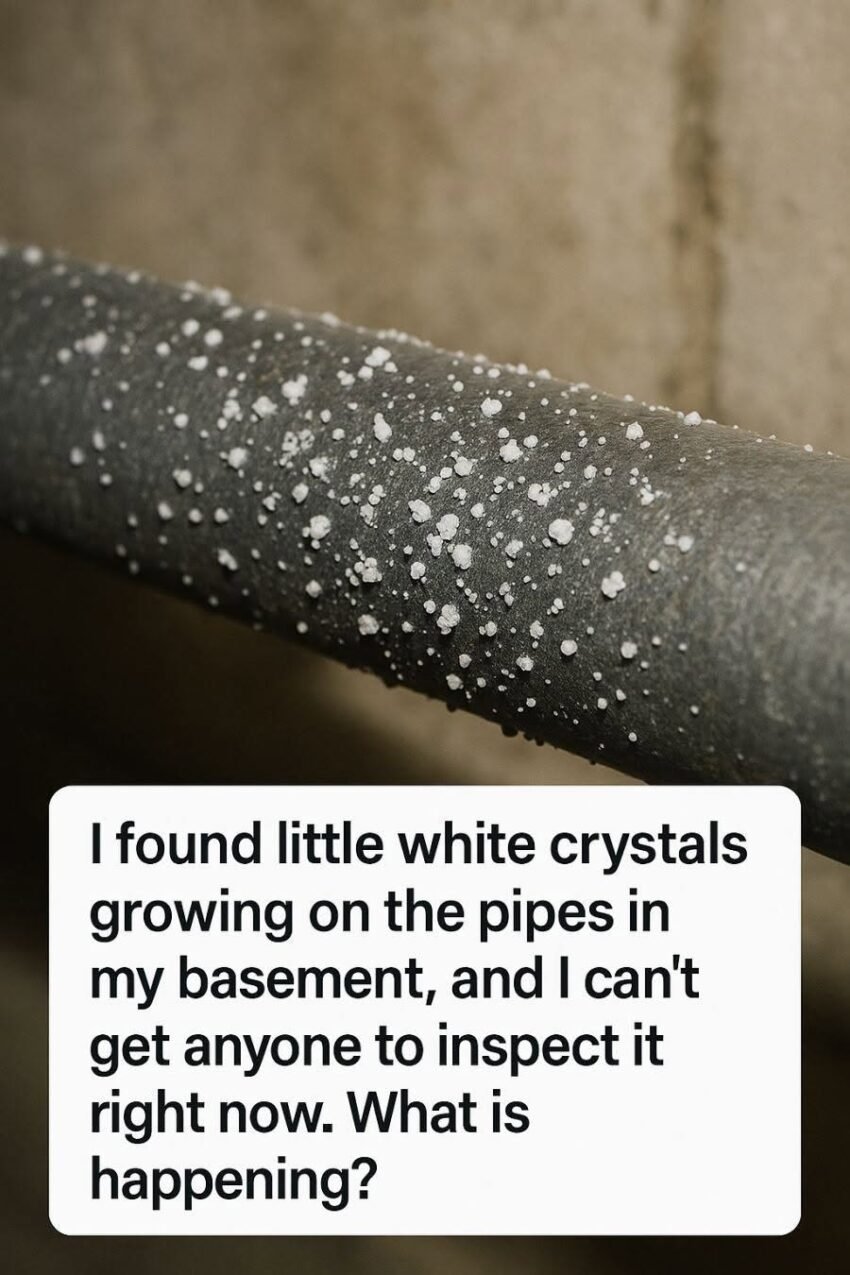
Here are the most common possibilities:
1. Mineral deposits (most common)
The white crystals may be calcium carbonate, lime scale, or other mineral salts left behind when water evaporates.
How it happens:
- A pipe has a tiny leak, condensation, or sweating.
- Water reaches the outside of the pipe.
- The water evaporates.
- Dissolved minerals remain and slowly build up into white crusts or crystals.
They often look like:
- White, chalky crust
- Small spikes or fluffy crystal growth
- Powdery material that flakes off
- Hard deposits attached around joints, valves, or seams
This is especially common with:
- Copper pipes
- Galvanized pipes
- Water supply lines
- Areas with hard water
2. Efflorescence (salt crystals from moisture movement)
If the pipes run through concrete walls, floors, or masonry, the crystals may not be from the pipe itself.
Concrete and masonry contain salts. When moisture moves through them, it can carry those salts to the surface. When the water evaporates, it leaves behind white crystalline growth.
Signs:
- White fuzzy or powdery coating
- Appears on nearby concrete, brick, or basement walls
- Returns after cleaning if moisture continues
3. A slow plumbing leak
A small leak is one of the most important things to rule out.
Check for:
- Crystals concentrated around pipe joints, fittings, valves, or elbows
- Green/blue stains on copper pipes (possible corrosion)
- Damp spots underneath pipes
- Water stains on wood or concrete
- Musty smells
A tiny leak can exist for months while only leaving mineral deposits.
4. Pipe corrosion
If the pipes are old, corrosion can create deposits.
Examples:
- Copper corrosion can produce green or blue deposits, sometimes mixed with white minerals.
- Galvanized steel pipes can develop white/gray crusts as the metal deteriorates.
5. Mold mistaken for crystals
Some fungal growths can look white, especially in damp basements.
Differences:
- Mineral crystals: hard, gritty, crystalline, chalky, do not smear easily.
- Mold: fuzzy, soft, may have a musty odor, can spread across surfaces.
Avoid disturbing unknown growths heavily until you know what it is.
What you can safely do right now
1. Take a close look
Without scraping aggressively:
- Is it hard like rock/salt or soft/fuzzy?
- Is it directly on the pipe, or on the wall/floor nearby?
- Is there moisture?
2. Dry the area
If possible:
- Wipe away surface moisture.
- Improve basement ventilation.
- Use a dehumidifier if humidity is high.
3. Check for active leaks
Run water fixtures in the house and watch the area:
- Does it become wet?
- Do new droplets appear?
- Does the crystal area grow?
4. Avoid harsh chemicals
Do not pour strong acids or cleaners on pipes before knowing the pipe material. Some cleaners can damage plumbing or create fumes.
When it needs urgent attention
Try to get someone to inspect it sooner if you notice:
- Active dripping
- A wet ceiling/floor/wall
- Rapid crystal growth
- Rusted or bulging pipes
- Sewage smell
- Reduced water pressure
- A pipe that looks damaged
If you can describe:
- What type of pipe it is (copper, PVC plastic, black iron, galvanized metal),
- Where the crystals are (joint, middle of pipe, wall, floor),
- Whether they are hard crystals, powder, or fuzzy,
- A photo if you can upload one,
I can help narrow down what it most likely is.