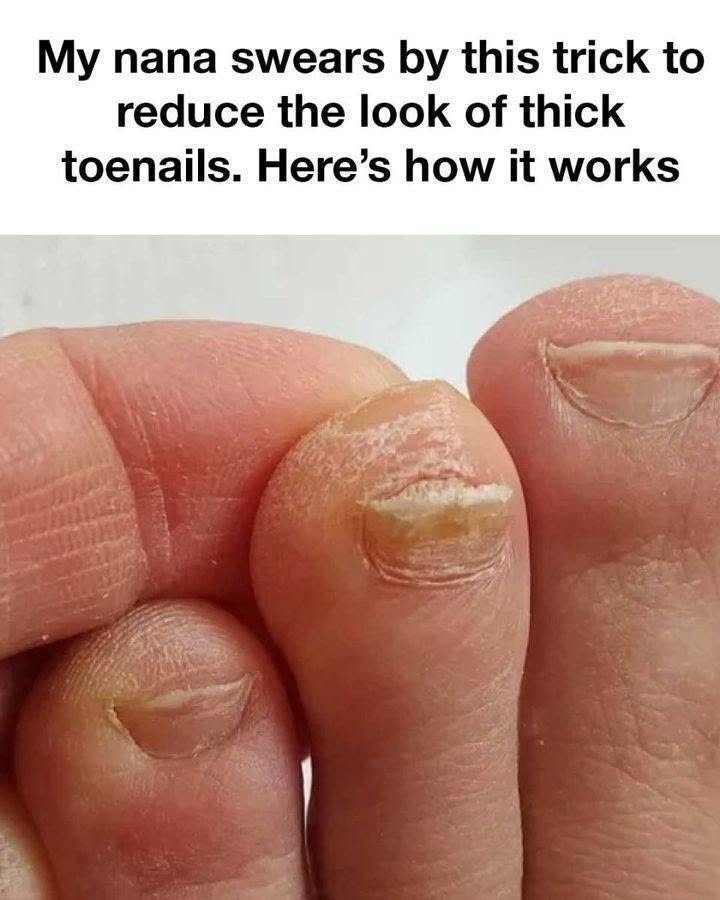
Here’s a detailed explanation of a commonly recommended home-care approach:
Step 1: Soak the Feet
Fill a basin with warm (not hot) water.
Soak your feet for 10–20 minutes to soften the nails.
Some people add Epsom salt, but there is limited evidence that it reduces nail thickness—it mainly helps soften the skin and can feel soothing.
Step 2: Dry Thoroughly
Dry your feet completely, especially between the toes.
Moisture trapped around the feet can encourage fungal growth.
Step 3: Trim the Nail
Use clean, sharp toenail clippers.
Cut the nail straight across.
Avoid cutting the corners too deeply, as this can lead to ingrown toenails.
Step 4: Gently File the Nail
Use an emery board or a nail file.
File the surface and edges gently to reduce the nail’s thickness and smooth its appearance.
Don’t file so aggressively that you cause pain or expose sensitive tissue.
Step 5: Moisturize
Apply a moisturizer containing urea (10–40%) or lactic acid if recommended by a healthcare professional. These ingredients can help soften thick nails over time and may make them easier to trim.
Does This Actually Work?
This routine can:
Make thick nails look smoother.
Reduce pressure from bulky nails inside shoes.
Make trimming easier.
Improve comfort.
However, it does not treat the underlying cause, especially if the thickening is due to a fungal infection or another medical condition.
If the Cause Is Nail Fungus
If a fungal infection is responsible:
Home filing alone won’t eliminate the fungus.
Over-the-counter antifungal products may help in mild cases, but many infections require prescription treatment.
Oral antifungal medications prescribed by a clinician are generally more effective than topical treatments for established fungal nail infections.
When to See a Healthcare Professional
Consider seeing a doctor or podiatrist if:
The nail becomes painful.
It turns yellow, brown, black, or green.
The nail starts lifting away from the nail bed.
There is redness, swelling, or drainage.
You have diabetes, poor circulation, or a weakened immune system.
The nail keeps getting thicker despite regular care.
Common “Nana” Home Remedies
Some traditional remedies include:
Vinegar soaks: There is limited scientific evidence that they treat thick or fungal nails.
Tea tree oil: Some laboratory studies suggest antifungal activity, but clinical evidence for treating toenail fungus is limited and inconsistent.
Vicks VapoRub: Small studies have reported modest improvements in some people with fungal nails, but it is not considered a proven treatment.
Key Takeaway
The safest and most effective “trick” for reducing the look of thick toenails is to soften the nail by soaking it, trim it carefully, and gently file it on a regular basis. If the nail is becoming progressively thicker, discolored, painful, or affecting daily activities, it’s a good idea to have it evaluated so the underlying cause can be identified and treated appropriately.