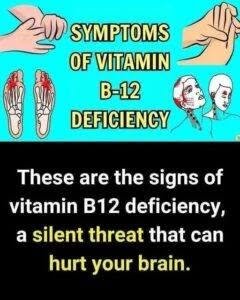
Vitamin B12 deficiency can develop slowly, and some of its most important symptoms involve the nervous system, not just anemia. Because neurological problems can occur even when there is no obvious anemia, persistent or unexplained symptoms deserve medical evaluation.
Signs of Vitamin B12 Deficiency You Should Never Ignore
1. Persistent, unexplained tiredness
One of the most common symptoms is fatigue that doesn’t improve with adequate sleep.
B12 is needed to make healthy red blood cells. When B12 is deficient, the body can develop megaloblastic anemia, in which red blood cells are abnormally large and don’t function normally. This can reduce oxygen delivery to tissues and cause:
- Constant tiredness
- Weakness
- Low energy
- Reduced exercise tolerance
- Feeling exhausted after ordinary activities
- Shortness of breath with exertion
Fatigue has many possible causes, so it does not automatically mean you have a B12 deficiency.
2. Numbness, tingling, or “pins and needles”
This is one of the symptoms that deserves particular attention.
You may experience:
- Tingling in your fingers or toes
- Numbness in the hands or feet
- Burning or prickling sensations
- A feeling similar to your foot “falling asleep”
- Reduced ability to feel temperature or touch
These symptoms can occur because B12 is important for normal nerve function. Importantly, neurological symptoms can occur even without anemia, so a normal-looking blood count does not necessarily rule out B12-related nerve problems.
3. Balance or walking problems
B12 deficiency can affect the nerves involved in coordination, sensation, and balance.
Watch for:
- Feeling unusually unsteady
- Frequently stumbling
- Difficulty walking in a straight line
- Increased falls
- Feeling as though the floor is moving beneath you
- Difficulty knowing where your feet are without looking
Balance problems together with numbness or tingling should be evaluated promptly because neurological damage can become difficult to reverse if deficiency remains untreated.
4. Memory and concentration problems
B12 deficiency can sometimes affect cognitive function.
Possible symptoms include:
- Forgetfulness
- Difficulty concentrating
- “Brain fog”
- Trouble finding words
- Difficulty following conversations
- Reduced mental sharpness
- Confusion
More severe deficiency has been associated with significant cognitive changes, including dementia-like symptoms. However, these symptoms have many other possible causes, so testing is important rather than assuming B12 is responsible.
5. Mood changes
Some people with B12 deficiency experience psychological or mood-related symptoms, including:
- Depression
- Irritability
- Anxiety
- Reduced motivation
- Changes in mood
- Confusion
The relationship between B12 status and mental health is complex, and depression or anxiety alone does not prove B12 deficiency. Nevertheless, unexplained mood changes occurring alongside neurological or blood-related symptoms warrant discussion with a healthcare professional.
6. A swollen, sore, or unusually smooth tongue
Another recognizable symptom is glossitis, inflammation of the tongue.
You might notice:
- A painful tongue
- Burning sensation
- Swelling
- Redness
- A smooth-looking tongue
- Increased sensitivity to spicy or acidic foods
B12 deficiency can also cause soreness inside the mouth.
7. Pale skin
B12 deficiency can contribute to anemia, which may make the skin appear paler than usual.
Some people may also notice that their complexion looks unusually washed out or that the inside of the lower eyelids appears pale.
Again, pale skin isn’t specific to B12 deficiency; iron deficiency and other forms of anemia can cause similar changes.
8. Heart palpitations or a fast heartbeat
When anemia becomes significant, the heart may have to work harder to deliver enough oxygen around the body.
You may notice:
- A racing heartbeat
- Fluttering or pounding in the chest
- Heart palpitations
- Shortness of breath
- Reduced ability to exercise
These symptoms can have many causes. New or severe chest symptoms, fainting, or significant breathing difficulty require urgent medical attention, rather than assuming they are caused by B12 deficiency.
9. Unexplained weight loss or reduced appetite
B12 deficiency can be associated with:
- Reduced appetite
- Unintentional weight loss
- General weakness
Significant or unexplained weight loss should always be evaluated because many medical conditions can cause it.
10. Vision problems
Less commonly, B12 deficiency can affect the optic nerve and contribute to visual problems.
Possible warning signs include:
- Blurred vision
- Changes in visual clarity
- Difficulty seeing normally
NICE evidence reviews include optic nerve dysfunction/blurred vision among possible manifestations of B12 deficiency.
11. Unexplained weakness
B12 deficiency-related anemia and neurological involvement can produce generalized weakness.
You might notice that activities that were previously easy—such as climbing stairs, carrying groceries, or exercising—suddenly require considerably more effort.
Weakness accompanied by numbness, balance problems, or cognitive changes is particularly important to discuss with a clinician.
12. Headaches
Some people with B12 deficiency experience headaches, although headaches are not specific to B12 deficiency and have numerous other causes.
Persistent, unexplained headaches combined with fatigue, neurological symptoms, or anemia may warrant investigation. NICE’s evidence review lists unexplained chronic headache/migraine among symptoms considered in relation to B12 deficiency.
Why B12 deficiency can be particularly serious
Vitamin B12 has important roles in:
- Making DNA
- Producing healthy blood cells
- Maintaining nerve cells
- Maintaining normal neurological function
The body stores substantial amounts of B12, so deficiency can take years to become clinically apparent.
The major concern is that prolonged deficiency can cause neurological damage. This is why symptoms such as numbness, tingling, balance problems, or cognitive changes shouldn’t simply be ignored.
Importantly, you don’t necessarily have to be anemic to have neurological effects from B12 deficiency.
Who is more likely to develop B12 deficiency?
Risk is higher in people who:
- Eat little or no animal products without reliable B12-fortified foods or supplementation
- Are older adults
- Have pernicious anemia
- Have certain stomach or intestinal disorders
- Have had some stomach or intestinal surgeries
- Have conditions such as Crohn’s disease or celiac disease
- Have problems producing stomach acid or intrinsic factor
- Take certain medications for prolonged periods, including metformin or proton-pump inhibitors, which can interfere with B12 status in some people
Vitamin B12 occurs naturally in foods such as fish, meat, poultry, eggs, milk, and other dairy products. Plant foods don’t naturally contain B12 unless they have been fortified.
How is vitamin B12 deficiency diagnosed?
Symptoms alone aren’t enough to diagnose it.
A healthcare professional may use:
1. Complete blood count (CBC)
This can identify anemia and changes in red blood-cell size.
2. Serum vitamin B12
A blood test measures circulating B12.
3. Methylmalonic acid (MMA)
This can be particularly useful when the B12 result is borderline. NIH notes that MMA is one of the more sensitive markers of B12 status.
4. Homocysteine
This can also increase when B12 status is inadequate, although it is less specific because other factors can affect it.
Depending on the situation, a clinician may also investigate why the deficiency occurred—for example, dietary intake, absorption problems, pernicious anemia, gastrointestinal disease, or medication use.
What happens if B12 deficiency is confirmed?
Treatment depends on the cause and severity.
B12 replacement can be given as:
- Oral B12
- High-dose oral B12 in appropriate circumstances
- Intramuscular B12 injections
Injections may be particularly useful when absorption is impaired. NIH notes that high-dose oral B12 can also be effective in some people.
The important point is not simply to start a supplement and ignore the underlying cause. If the problem is poor absorption or pernicious anemia, dietary changes alone may not correct it.
How much B12 do adults need?
For most adults, the recommended daily amount is 2.4 micrograms (mcg). Requirements are higher during pregnancy and breastfeeding.
Interestingly, B12 supplements frequently contain much larger amounts—such as 500 or 1,000 mcg—because only a fraction is absorbed. NIH notes that B12 has no established upper intake limit because it is generally considered to have a low potential for toxicity.
That does not mean everyone needs a high-dose supplement.
When should you see a doctor?
Consider arranging a medical evaluation if you have persistent or unexplained:
- Fatigue or weakness
- Numbness or tingling
- Balance or walking difficulties
- Memory/concentration changes
- Mood changes
- A sore or swollen tongue
- Pale skin
- Palpitations
- Unexplained weight loss
- Vision changes
Especially important
Numbness/tingling + balance problems + weakness or cognitive changes should not be dismissed as simply “getting older” or being tired. B12 deficiency is one potentially treatable cause of neurological symptoms, and early treatment is important because prolonged neurological injury may not completely reverse.
And remember: having one of these symptoms does not mean you have B12 deficiency. Iron deficiency, folate deficiency, thyroid disorders, diabetes, neurological conditions, medications, sleep problems, and many other conditions can produce similar symptoms.
If you’d like, I can also give you a detailed list of Vitamin B12 deficiency symptoms by stage (early, moderate, and severe), B12-rich foods, normal B12 blood-test ranges, and treatment options.