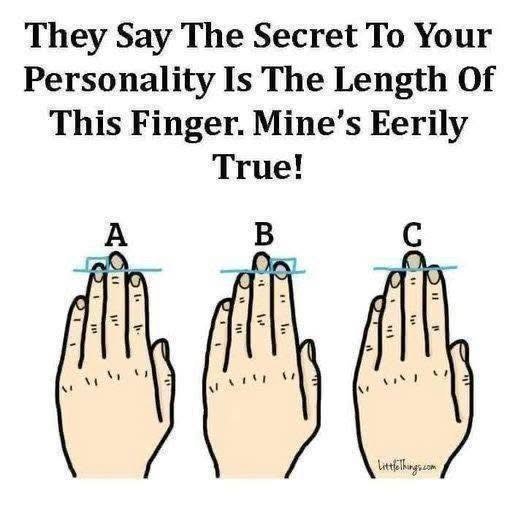
If you mean the viral claim that the length of your ring finger compared with your index finger reveals your personality, the science is much more interesting—and much less certain—than those headlines suggest.
The “finger personality” theory
The finger in question is usually the ring finger (4D), compared with the index finger (2D). Researchers call this the 2D:4D ratio:
2D:4D = index-finger length ÷ ring-finger length
- Lower 2D:4D: ring finger is relatively longer than the index finger.
- Higher 2D:4D: index finger is relatively closer in length to, or longer than, the ring finger.
The theory became popular because researchers have investigated whether this ratio is associated with prenatal hormone exposure, particularly androgen and estrogen signaling, during fetal development.
What does it supposedly say about personality?
You’ve probably seen claims such as:
Longer ring finger → more assertive, competitive, risk-taking, athletic, or adventurous.
Longer index finger → more cautious, cooperative, sensitive, or less aggressive.
Some studies have reported associations between a lower 2D:4D ratio and traits such as competitiveness, certain types of risk-taking, athletic performance, and aspects of behavior.
But here’s the important part: a finger-length ratio cannot reliably tell you what kind of personality you have.
The relationships found in research are generally small, inconsistent, and heavily dependent on the particular trait and population being studied.
Why people find it “eerily true”
There’s a psychological trick that makes these claims feel remarkably personal.
Personality descriptions such as:
“You’re competitive but also sensitive.”
“You can be social, but sometimes you need time alone.”
“You tend to take risks, but you’re cautious when something really matters.”
apply to an enormous number of people.
This is related to the Barnum/Forer effect—our tendency to recognize vague, generally applicable personality statements as uniquely descriptive of ourselves.
There’s another issue: if someone already knows their own personality, they’re much more likely to remember the predictions that fit and overlook the ones that don’t.
But is there any real science behind the finger ratio?
Yes—but it’s frequently exaggerated online.
Scientists have genuinely studied 2D:4D for decades. The hypothesis is that the ratio may contain some information about developmental biology, potentially including prenatal hormone signaling.
However, that’s very different from saying:
“Your ring finger determines your personality.”
It doesn’t.
Think of it more like a weak statistical association rather than a personality test.
For example, even if a study finds that people with a particular finger ratio are slightly more likely to exhibit a certain characteristic, that doesn’t mean an individual with that ratio necessarily has that characteristic.
And there’s an even bigger problem
Measuring your fingers isn’t as straightforward as TikTok videos make it appear.
Results can vary depending on:
- where you measure from
- whether you measure the palm-side or back of the hand
- finger curvature
- measurement error
- age and sex
- which hand you use
- the population being studied
And researchers don’t always find the same relationships between 2D:4D and behavior.
So if a social-media article tells you that one specific finger can reveal whether you’re dominant, loyal, aggressive, intelligent, sexually adventurous, destined to be successful, or compatible with someone, that’s going far beyond what the evidence supports.
What about attractiveness, relationships, or sexuality?
This is where online articles often get especially sensational.
You may encounter claims connecting 2D:4D with sexual orientation, sexual behavior, fertility, attractiveness, aggression, or mate preferences.
There have been scientific studies investigating some of these questions, but the findings are far from strong enough to use someone’s finger measurements as an individual prediction.
In other words, your hand isn’t a biological horoscope.
So why does the claim keep going viral?
Because it’s a perfect internet story:
“Look at your hand → discover something hidden about yourself.”
It’s immediate, easy to test, visually compelling, and produces lots of anecdotes.
And anecdotes are particularly persuasive here. If you look at your hand and think, “Wow, that totally explains why I’m competitive!”, you’ve experienced something emotionally convincing—but that isn’t the same thing as demonstrating that the finger caused or accurately predicts the trait.
The bottom line
Your ring-to-index-finger ratio may contain a small amount of information about certain biological or behavioral tendencies at the population level, and researchers are legitimately interested in why.
But it cannot accurately determine your personality as an individual.
So if the article told you, “Measure this finger and discover who you really are,” take that with a substantial grain of salt.
If you tell me whether your index finger or ring finger is longer (and whether it’s your left or right hand), I can explain what the viral theory says about your result—and then separate what the claim says from what scientific research actually supports.