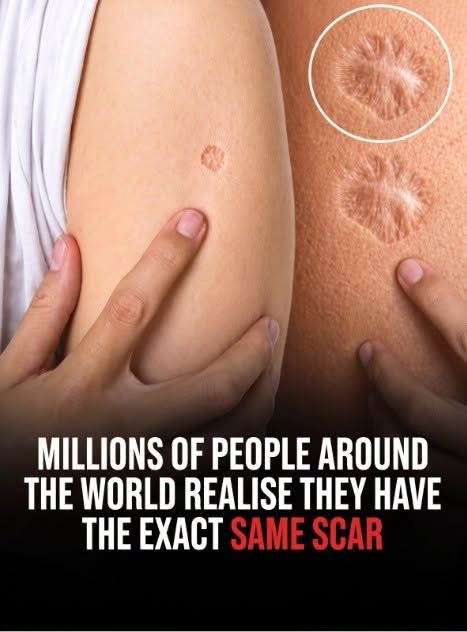
Why Do So Many People Have the Same Small Scar?
You may have noticed that many people have a small, round or oval scar on their upper arm, shoulder, or sometimes another part of their body. The most famous example is the small, indented scar that some people have on their upper arms.
The most common explanation is vaccination, particularly the smallpox vaccine. However, not everyone with a similar-looking scar has the same cause.
1. The smallpox vaccination scar


For generations, people in many countries received the smallpox vaccine, which often left a distinctive scar. Smallpox was a serious, highly contagious disease that caused fever and a characteristic rash, and vaccination was used to prevent it.
Here’s why the scar looks similar on so many people:
-
The vaccine was administered in a distinctive way. Unlike most modern injections, the traditional smallpox vaccine was usually delivered by repeatedly puncturing the skin with a special, bifurcated needle.
-
It caused a local skin reaction. The vaccine often produced a small blister or lesion that later formed a scab.
-
The healing process left a mark. As the skin healed, it could leave a round, pitted or slightly sunken scar.
-
Millions of people received it. Because vaccination programs were widespread, many people born in certain decades and regions developed similar scars.
Smallpox vaccination was especially widespread during the 20th century. The World Health Organization declared smallpox eradicated in 1980, following a global vaccination and surveillance campaign. Routine smallpox vaccination subsequently stopped in most countries.
2. Why the scar is so distinctive


The scar is unusual because the vaccine was designed to produce a visible skin reaction.
The process typically followed this pattern:
-
Days 1–4: The vaccination site begins to develop a bump.
-
Days 5–10: A blister develops and may fill with fluid or pus.
-
Days 10–14: The lesion dries out and forms a scab.
-
Around weeks 2–3: The scab falls off, sometimes leaving a permanent, indented scar.
The precise timing varies from person to person. This reaction was a normal part of successful vaccination with the traditional smallpox vaccine.
3. Why do some people have the scar while others don’t?
In the United States, routine smallpox vaccination ended in 1972. This means that many Americans born before or around that period may have the scar, while most people born afterward do not, unless they were vaccinated for another reason.
The timing differs across countries because vaccination programs ended at different times. Some countries continued routine vaccination for longer than the United States.
Other factors include:
-
Whether the person received the vaccine.
-
Whether the vaccine produced the typical skin reaction.
-
How deeply the skin healed and whether a visible scar remained.
-
The person’s country of birth and childhood vaccination history.
4. Could the scar be from another vaccine?
Yes. One important alternative is the BCG vaccine, which protects against tuberculosis.


The BCG vaccine is commonly administered in countries where tuberculosis is more prevalent. It can also leave a small, round scar on the upper arm.
|
Feature |
Smallpox vaccine scar |
BCG vaccine scar |
|---|---|---|
|
Main purpose |
Prevent smallpox |
Help protect against tuberculosis |
|
Typical location |
Upper arm |
Upper arm, often the shoulder area |
|
Appearance |
Often round and indented, sometimes pitted |
Often round, sometimes raised or indented |
|
Historical pattern |
Common among generations vaccinated against smallpox |
Common in populations with routine BCG vaccination |
Appearance alone cannot reliably tell you which vaccine caused a particular scar.
5. Does the scar mean the person had smallpox?
No. This is a very common misconception.
A smallpox vaccination scar usually means the person received the vaccine, not that they contracted smallpox. The vaccine used a related virus called vaccinia to stimulate immunity; it did not contain the virus that causes smallpox.
Smallpox itself was much more severe. Survivors could have numerous scars across their faces and bodies, rather than just one small mark on an arm.
6. Why is this scar still so common today?
The simplest explanation is that vaccination campaigns reached enormous numbers of people across generations and countries. Because the vaccine was administered using a similar technique, it often left a similar mark.
The scar is therefore a small physical reminder of one of the largest public-health achievements in history: the global eradication of smallpox, declared by the World Health Organization in 1980.
One detail can help identify which scar you’re asking about: Is it a small, round, slightly sunken scar on the upper arm, or a different type of mark that you’ve noticed on many people? The location and appearance can help distinguish a smallpox vaccination scar from a BCG vaccination scar or another cause.